
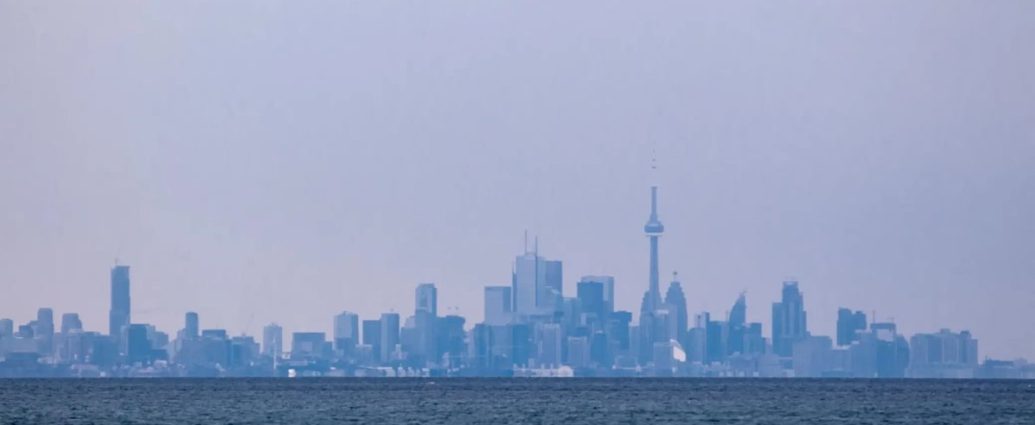
A thick haze settled over Hamilton and Toronto this morning, and honestly? It’s something you don’t see often in March. Environment Canada issued a winter air quality warning – the kind of alert that usually shows up during summer heat waves, not when there’s still snow on the ground.
The federal weather folks say atmospheric conditions are trapping pollutants close to the ground. They’re calling it “poor to very poor” air quality across the Greater Toronto Area. Which, let’s be real, isn’t the kind of news anyone wants to wake up to.
This isn’t your typical summer smog situation either.
Winter air quality warnings are rare because cold temperatures usually help disperse all the junk we pump into the air. But right now we’ve got a perfect storm brewing – light winds, temperature inversions, and all the usual emissions from cars and heating systems. It’s created this mess right in the heart of Canada’s most populated region.
Over 6.2 million people are dealing with this across the GTA and surrounding areas.
That makes it one of the most significant winter air quality events anyone can remember. Environment Canada issued the alert at 6:42 AM after overnight monitoring showed particulate matter levels climbing steadily since 2 AM. So while most of us were sleeping, the air was getting progressively worse.
What’s Behind All This Haze
The science here is actually pretty wild, if you’re into this kind of thing.
We’re dealing with what meteorologists call a temperature inversion (no, seriously). Normally, air gets colder as you go higher up. That allows pollutants to rise and spread out. Makes sense, right?
But right now there’s a layer of warm air sitting on top of cooler air near the surface.
Think of it like putting a lid on a pot. All the exhaust from cars, trucks, industrial facilities, and home heating systems has nowhere to go. It’s just sitting there, building up in the lower atmosphere like a really unpleasant soup. The light winds aren’t helping either – there’s barely any air movement to push this stuff somewhere else.
Environment Canada’s monitoring stations are showing fine particulate matter levels well above what we’d consider safe. Current readings show PM2.5 concentrations between 45 and 62 micrograms per cubic meter. The Canadian standard sits at 27 micrograms, so we’re way over the line here. These particles are tiny – about 30 times smaller than the width of a human hair – which means they can get deep into your lungs and even enter your bloodstream. Not exactly what you want floating around in the air you’re breathing.
The inversion layer is sitting roughly 300 meters above ground level. Environment Canada meteorologist Sarah Chen describes it as an “atmospheric dome” over the region. Wind speeds have dropped to less than 5 kilometers per hour, compared to the seasonal average of 15-20 kilometers per hour for March.
So basically, the air isn’t moving much at all.
“We’re seeing textbook conditions for air quality deterioration,” says Dr. Michael Rodriguez, an atmospheric scientist at York University. “The inversion layer is acting like a ceiling, and with minimal wind movement, we’re essentially living inside a snow globe filled with pollutants instead of snow.”
Why Your Lungs Won’t Thank You Today
Here’s where this gets serious for anyone with breathing problems.
The health warnings aren’t just bureaucrats being overly cautious. Poor air quality can genuinely mess with your respiratory system, especially if you’ve got asthma, COPD, or heart conditions. Hamilton Health Sciences reports a 34% increase in emergency department visits for respiratory complaints since 8 AM this morning compared to the same time last Tuesday. That’s a real jump in people needing medical help just because of what’s in the air.
Toronto’s Hospital for Sick Children has activated its air quality protocol. They’re advising parents to keep children with asthma indoors and make sure rescue inhalers are within easy reach.
People with lung or heart disease, older adults, children, and people who are active outdoors are advised to reduce or reschedule strenuous activities outdoors.
The symptoms aren’t subtle either. We’re talking coughing, throat irritation, headaches, and shortness of breath. If you’re someone who goes for morning runs or bikes to work, today’s probably not the day for that outdoor workout. The recommendation is to keep outdoor activities light or move them indoors if you can swing it.
Kids are particularly vulnerable because their lungs are still developing and they breathe faster than adults. If you’ve got little ones, keep them inside during recess or after-school outdoor time. Schools in the affected areas have been notified and many are moving activities indoors. Nobody wants to deal with a bunch of kids having breathing problems because they were playing outside in this mess.
Dr.
No surprise there.
What This Means Going Forward
Lisa Thompson, chief of emergency medicine at Hamilton General Hospital, says they’ve treated 28 patients since midnight with symptoms directly related to poor air quality. That compares to an average of 8 patients during a typical March night. The majority are adults over 65 and children under 12 – the groups most vulnerable to air quality problems.
How Far This Thing Spreads
The warning covers a massive area. We’re talking Hamilton, Toronto, Mississauga, Brampton, Markham, Richmond Hill, and basically everything in between. The haze is visible from satellite imagery, stretching from Lake Ontario north to Barrie and east toward Oshawa. That’s roughly 7,500 square kilometers of crappy air quality.
Environment Canada has 23 monitoring stations scattered throughout the region, and they’re all showing elevated readings.
The Air Quality Health Index runs from 1 to 10+, and we’re sitting at 7 to 9 across most of the area. Anything above 7 is considered “high risk.” So yeah, we’re definitely in the danger zone.
What’s particularly concerning is how quickly this developed.
Yesterday’s air quality was totally fine, sitting around a 3 or 4 on the index. But the atmospheric conditions shifted overnight, and by morning rush hour we’re dealing with this situation. It really shows how fast things can change when weather patterns go sideways.
The hardest-hit areas include downtown Hamilton with an index reading of 9, Toronto’s downtown core at 8, and the Highway 401 corridor through Mississauga also at 8. Visibility has dropped to less than 8 kilometers in some areas, compared to normal March visibility of 15-25 kilometers.
You can literally see the difference when you look outside.
Pearson International Airport reports delays for 47 flights so far today due to reduced visibility, with an average delay time of 23 minutes for departing flights. Porter Airlines has cancelled 6 flights to and from Billy Bishop Airport citing safety concerns related to visibility conditions. So if you’re flying today, check your flight status before heading to the airport.
When Does This Nightmare End
The million-dollar question everyone’s asking: when does this end?
Environment Canada’s forecasters say we need a weather pattern change to break up this inversion layer. The good news is that’s expected to happen within the next 24 to 48 hours. A low-pressure system moving in from the west should bring some wind and potentially some precipitation, which would help wash out the pollutants. But until then, we’re basically stuck with these conditions.
Meteorologists predict the inversion will begin breaking up Thursday evening around 8 PM, with winds picking up to 15-20 kilometers per hour from the northwest.
There’s a 60% chance of light rain Thursday night, which would help wash particulates out of the atmosphere (sound familiar?). Rain is basically nature’s air filter, so fingers crossed we get some.
The timing really isn’t great either. March is when a lot of people are itching to get back outside after a long winter. Parks and trails that were packed last weekend are going to be a lot quieter today. Running groups are cancelling outdoor sessions, and youth sports leagues are moving practices indoors. Spring fever will have to wait a bit longer.
The Toronto District School Board has moved all outdoor activities indoors for 247 schools across the region.
That’s affecting approximately 156,000 students. Outdoor lunch periods have been cancelled, and school buses are running with windows closed and air filtration systems on maximum. Kids are probably wondering why they can’t play outside on what looks like a normal day.
The Money Side of Bad Air
This air quality event isn’t just a health concern – it’s hitting the regional economy too.
GO Transit reports ridership is up 18% this morning as more people choose public transit over walking or cycling to work. The agency has added extra cars to several train lines and increased bus frequency on major routes by 25%. When people can’t walk or bike to work, they need other options, and that puts strain on the transit system.
Construction sites across the GTA are implementing modified work schedules.
Outdoor workers are taking more frequent breaks and some projects have been temporarily halted. The Ontario Construction Association estimates productivity losses of $2.3 million per day when air quality reaches these levels. That’s real money being lost because people can’t work safely outdoors.
Retail businesses are feeling the impact too.
Outdoor farmers markets scheduled for today in Hamilton and Toronto have moved indoors or postponed operations. The Evergreen Brick Works cancelled its outdoor programming, potentially affecting 400 visitors who had pre-registered for activities. When you can’t breathe properly outside, tourism and recreation take a hit.
Tourism operators are adapting quickly though. CN Tower’s EdgeWalk experience, which typically sees 150 participants daily in March, has been suspended until air quality improves. Casa Loma has waived admission fees for its indoor gardens to provide families with alternative activities. At least there are some indoor options for people who had outdoor plans.
The Bigger Picture for Canadians
This event highlights something climate scientists have been talking about for years. Changing weather patterns can affect air quality in ways nobody really expected. Winter inversions like this might become more common as our climate continues to shift, and that has implications for urban planning and public health preparedness right across Canada.
Here’s the ironic part though.
Our overall air quality has actually improved dramatically over the past few decades. Federal data shows PM2.5 levels in Toronto have dropped 47% since 1998, thanks to stricter emissions standards for vehicles and industry. We’re pumping out way less pollution than we were in the 1980s and 90s. But when weather conditions trap what’s still being emitted, you get days like today where everything goes to hell.
Urban planning folks are paying attention to events like this too. The concentration of people, vehicles, and industry in the Greater Toronto Area means that when atmospheric conditions go sideways, millions of people get affected all at once. City planners are now factoring air quality resilience into development decisions, including where to put green corridors and how to zone industrial areas. It’s not just about building stuff anymore – it’s about building stuff that can handle these kinds of events.
Health Canada estimates that poor air quality costs the Canadian healthcare system $36 billion annually in direct medical costs and lost productivity. Events like today’s, while temporary, contribute significantly to emergency department strain and missed work days across the region. That’s a huge economic burden that goes way beyond just feeling a bit crappy when you breathe.
“This is a wake-up call for urban resilience planning,” says Dr. Jennifer Walsh, director of environmental health at the University of Toronto. “We need infrastructure that can protect public health when normal atmospheric conditions fail us. That means better building ventilation, more indoor public spaces, and emergency protocols that can scale up quickly.”
What You Should Actually Do Right Now
If you’re in the affected area, here’s the practical stuff that matters.
Keep windows closed, set your car to recirculate air instead of pulling in outside air, and if you’ve got an air purifier at home, now’s definitely the time to use it. HEPA filters are particularly effective at removing PM2.5 particles – the tiny stuff that’s causing all the problems today.
For anyone with pre-existing health conditions, don’t mess around with this. If you’re feeling short of breath or having chest tightness, contact your healthcare provider. The emergency rooms in Hamilton and Toronto are already seeing more respiratory-related visits, with wait times averaging 3.2 hours compared to the usual 2.1 hours for non-urgent cases. Nobody wants to spend their day in the emergency room, but if you’re having trouble breathing, that’s where you need to be.
Public libraries across the region are extending hours and waiving guest policies to provide clean air refuges for residents without adequate home air filtration. Toronto Public Library reports 23% higher than normal foot traffic at its 100 branches since the warning was issued. Libraries aren’t just about books anymore – they’re becoming community havens when the outdoor air gets dangerous.
Community centers are also opening their doors early and staying open later. The City of Hamilton has activated 12 clean air shelters in community centers, while Toronto has opened 15 locations with free access and enhanced air filtration systems. If your home doesn’t have good air filtration, these places can literally be lifesavers.
What This Means Going Forward
Look, this won’t last forever. Weather systems are constantly moving, and this stagnant pattern will break eventually. But for now, the message from health officials is crystal clear: take it easy outdoors until the air clears. Environment Canada will update the advisory every 6 hours, with the next update scheduled for 2 PM this afternoon. Check back then to see if things are improving.
Frequently Asked Questions
How long will the winter air quality warning last?
Environment Canada expects conditions to improve within 24 to 48 hours as a weather system brings wind and potentially precipitation to clear the air.
What causes a winter air quality warning to be issued?
Temperature inversions trap pollutants near the ground when warm air sits above cooler surface air, combined with light winds that prevent dispersion.
Who is most at risk during poor air quality conditions?
People with lung or heart disease, older adults, children, and those who are physically active outdoors face the highest health risks.