
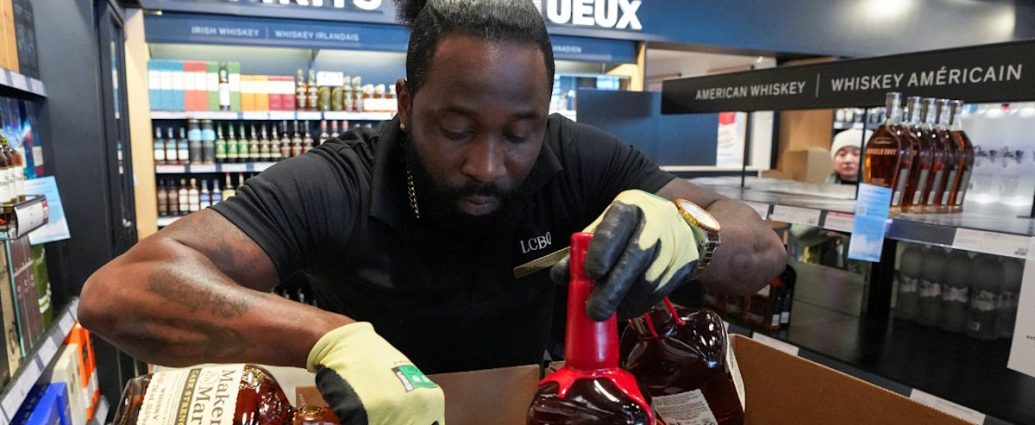
American whiskey exports to Canada have absolutely tanked, we’re talking nearly 70% down after a nasty trade fight that knocked the country from being the second-biggest buyer of US spirits all the way down to sixth place.
The numbers? They’re brutal. Canada went from a $250 million annual market to just $89 million in 2025. That’s what happens when you mess with people’s bourbon.
We’re looking at a $161 million wipeout in just one year. March through December 2025 tells the whole story. Exports crashed from $203 million down to $60 million. A $143 million nosedive in less than ten months.
When Things Went Sideways Fast
Here’s what’s really messing things up: most Canadian provinces are still keeping American alcohol out of their retail stores (to put it lightly). Even after some tariffs got lifted.
“Our industry thrives in a zero-for-zero tariff environment,” said Chris Swonger, president and CEO of DISCUS.
The whole mess started when Trump hit various goods with tariffs in early 2025. Canadian provinces fired back by pulling American spirits from government-run liquor stores. Classic back-and-forth stuff, except the booze industry got crushed in the middle.
Provincial response was quick and brutal. Within weeks of Trump’s tariff announcement in February 2025, provinces like Ontario, Quebec, and Manitoba had told their liquor control boards to yank American spirits from shelves.
Some Canadian officials called it “Liberation Day.” Liberation from what, exactly? Good whiskey?
Swonger gets that the Trump administration wants to fix trade imbalances. But he’s not thrilled about losing shelf space in Canada. The timing couldn’t have been worse for the industry, which had been cruising along with steady growth in Canadian sales over the previous five years. We’re talking about exports growing by an average of 8% annually from 2020 to 2024.
“Since Liberation Day, it’s unfortunate to report that our industry has lost over 70% of our exports to Canada because many provinces have decided not to carry American spirits,” Swonger said.
Kentucky Gets Hammered
Nobody’s hurting more than Kentucky right now.
The Bluegrass State cranks out 95% of the world’s bourbon supply. When Canada stops buying, Kentucky distilleries feel it immediately. We’re talking about 23,000 jobs and $9 billion in annual economic activity.
The state’s bourbon industry had been on fire, with production jumping 35% between 2019 and 2024 (not a typo). International demand was driving a lot of that growth.
Major distilleries like Jim Beam, Maker’s Mark, and Wild Turkey watched their Canadian shipments drop by 75% or more in 2025. Some smaller craft distilleries that’d built solid relationships with Canadian distributors? They lost their entire cross-border business overnight.
Owen Martin from Angel’s Envy says the problems go way beyond just shipping bottles across the border. His distillery had been moving roughly $2.3 million worth of bourbon annually to Canada before this trade mess started.
“There are the tariffs on finished goods and on us shipping abroad, but I’m even thinking a step below that,” Martin explained during an interview at the Angel’s Envy facility in Louisville on March 3, 2026.
Martin’s got a point about supply chain headaches. Bourbon has to age in new American oak barrels, that’s the law. You can only use those barrels once for bourbon. But Angel’s Envy uses port casks for finishing their bourbon, and those can be reused multiple times. These specialized barrels often come from Europe and face their own tariff pressures.
The barrel shortage has become a real headache.
New American oak barrels cost between $150 and $200 each. A typical distillery might need thousands per year. When export markets disappear, distilleries have to adjust their production forecasts, which affects how many barrels they order months or even years ahead of time.
“Those are the sorts of things, as a maker, that I have to be aware of in any given year. You have different opportunities and different challenges.”
What This Means Going Forward
Employment in Kentucky’s bourbon sector has taken a hit too. The big distilleries haven’t announced massive layoffs, but several have slowed hiring and delayed expansion plans. The Kentucky Distillers’ Association figures that roughly 1,200 jobs directly tied to Canadian exports have been affected.
How Provinces Turned Liquor Stores Into Political Tools
The real story here isn’t just about tariffs. It’s about how Canadian provincial governments decided to use liquor stores as weapons.
Ontario, Canada’s biggest province with 14.8 million people, was the largest market for American spirits before this trade war started.
The Liquor Control Board of Ontario ran 679 retail locations as of 2024. American whiskey had prime shelf space in most stores.
Quebec jumped in quickly. Its provincial liquor corporation SAQ pulled American spirits from 405 retail locations across the province. British Columbia’s BC Liquor Stores initially joined the boycott but started letting some American brands back onto shelves by late 2025.
The provincial bans created this weird patchwork across Canada. Private retailers in Alberta, which has a more open liquor retail system, kept selling American spirits throughout 2025. Saskatchewan held its ban through most of the year before quietly letting some brands return in December.
Manitoba’s approach was particularly nasty. The province didn’t just remove American spirits from Manitoba Liquor Marts, they also stopped private retailers from ordering new stock through the provincial distribution system. Complete embargo on American alcohol in a province of 1.4 million people.
Not great.
Look at how dramatic the provincial actions were. In Ontario alone, American spirit sales dropped from $78 million in 2024 to just $12 million in 2025. Quebec saw the same collapse, falling from $45 million to $8 million over the same period.
Two Whiskey Nations Acting Stupid
Swonger nailed it when he talked about how weird this whole situation is. Before the trade dispute, cross-border whiskey trade was booming both ways.
“American consumers love Canadian whisky, and Canadians love Kentucky bourbon. We’re hoping this gets resolved.”
The numbers prove his point. In 2024, Americans imported $387 million worth of Canadian whisky. That made it the third-largest spirits import category after vodka and tequila. Brands like Crown Royal, Canadian Club, and Forty Creek had loyal followings across the United States.
Canadian consumers had embraced American bourbon in a big way. Premium brands like Blanton’s and Pappy Van Winkle developed cult followings north of the border.
Bourbon tourism from Canada to Kentucky had been growing by double digits annually before the trade war started.
Before this mess, Canadian drinkers were happily buying American whiskey, and Americans were sipping Canadian rye. Cross-border whiskey festivals were common events, with distillers from both countries participating.
The Kentucky Bourbon Trail attracts more than 2.5 million visitors annually.
About 125,000 Canadian tourists used to visit each year before 2025. That number dropped by an estimated 40% in 2025 as the trade dispute soured relationships between distillers and Canadian distributors.
Now provincial governments are playing politics with people’s favourite bottles. The majority of provinces still haven’t restored American alcohol to their government-run stores. That’s the real problem here, not just the tariffs themselves.
Some provinces have been more flexible.
Alberta never fully joined the boycott, and its private retail system meant American spirits stayed available throughout 2025. British Columbia started restocking American whiskey in October 2025, though with way less selection compared to before the dispute.
What This Means If You’re Canadian and Like Bourbon
Canadian bourbon fans have probably noticed the empty shelves where their favourite Kentucky bottles used to sit.
The impact on what you can buy has been immediate and obvious.
Private retailers in some provinces can still carry American spirits, but the big government liquor stores control between 60% and 90% of retail sales in most provinces. When they stop stocking Jim Beam and Maker’s Mark, that’s a huge chunk of the market gone.
Pricing has gotten weird too.
Where American spirits are still available through private channels, prices have jumped by 15% to 25% on average. Without competition from government stores, which typically offer lower prices, private retailers have been able to mark up American brands big time.
Canadian whiskey drinkers have found ways around this. Cross-border shopping to US border towns increased noticeably in 2025. Liquor stores in places like Bellingham, Washington, and Plattsburgh, New York, started seeing way more Canadian customers.
Online ordering became another option, though it’s expensive and complicated by provincial regulations. Some Canadians have been ordering American whiskey through specialty importers, paying premium prices for brands that used to be easy to find at their local LCBO or SAQ.
The provincial bans were supposed to send a message to Washington about trade policy. Instead, they’re mostly punishing Canadian consumers who want access to American whiskey. Restaurant and bar owners have been particularly frustrated, their beverage programs built around American spirits suddenly faced supply shortages.
Thing is, some provinces have started bringing back American spirits. But it’s been slow and patchy. Alberta and British Columbia have been more open to restocking. Others are dragging their feet. Ontario announced in January 2026 that it would begin “gradually” restoring American spirits to LCBO shelves, but the process is expected to take months.
The Bigger Picture Here
This whiskey fight is part of Trump’s broader tariff strategy. His administration argues these moves strengthen US manufacturing and reduce trade imbalances, which hit $429 billion with all trading partners in 2024.
The original dispute started over steel and aluminum tariffs that Trump imposed in February 2025. National security concerns, he said. Canada responded with retaliatory tariffs on $16.6 billion worth of US goods, spirits, playing cards, toilet paper, and various consumer products.
But the spirits industry shows how messy trade wars get. You hit steel and aluminum with tariffs, and suddenly bourbon distillers in Kentucky are losing their second-biggest export market. Everything’s connected in modern trade, so disputes in one area quickly spread to others.
The distilling industry isn’t the only casualty. Canadian retaliatory tariffs have hit everything from playing cards to toilet paper. Hallmark Cards saw its Canadian exports drop by 45% in 2025. Georgia-Pacific’s tissue paper exports to Canada fell by 38% over the same period.
What makes the whiskey situation particularly frustrating for distillers is that North America used to be a free-trade zone for spirits. NAFTA eliminated most barriers starting in 1994. The industry thrived under those rules for three decades.
The USMCA technically still eliminates tariffs on spirits traded between the US and Canada. But the provincial retail bans have created barriers that are arguably more effective than any tax could be.
Trade economists estimate that the combined impact of tariffs and provincial bans has created an effective barrier equivalent to a 150% tax on American spirits in Canada. That’s enough to make most brands completely uncompetitive, even if they were allowed back on retail shelves.
What Happens Now
Swonger and his industry group are pushing hard for a return to “zero-for-zero” tariffs on spirits between the US and Canada. They’ve been lobbying both Washington and Ottawa, trying to get spirits carved out from broader trade disputes.
That would mean no tariffs either way. How things worked before this whole mess started. The industry has precedent on its side, during previous US-EU trade disputes, spirits were often excluded from retaliatory measures because both sides recognized the mutual benefits of whiskey trade.
DISCUS has proposed a “spirits peace treaty” that would guarantee tariff-free trade regardless of disputes in other sectors. Similar agreements exist between the US and several European countries, protecting cognac, Scotch whisky, and bourbon from getting caught up in unrelated trade fights.
Provincial governments hold the real power here.
They run most liquor retail in Canada, so they decide what goes on the shelves. Even if federal trade negotiators work out a deal, provinces could keep blocking American spirits if they want to make a political point.
The federal government in Ottawa has been putting pressure on provinces to restore American spirits to retail shelves. Sources close to the Prime Minister’s office suggest that continued provincial bans are hurting Canada’s position in broader trade negotiations with the US.
For Kentucky distillers, the math is simple: they need Canada back as a major market. Losing $161 million in annual exports isn’t something you just write off, especially for an industry that employs 23,000 people in a single state.
Some distilleries are already planning for Canada’s return.
Jim Beam has kept its Canadian distribution relationships alive, even though shipment volumes dropped to nearly zero. Maker’s Mark has kept its Canadian marketing team in place, betting that normal trade will come back eventually.
What This Means Going Forward
The question is whether provincial politicians are ready to stop using liquor stores as weapons in trade disputes. Canadian whiskey drinkers are certainly hoping so. Early 2026 polling suggests that 68% of Canadians support bringing American spirits back to government liquor stores.
Industry insiders expect most provinces to quietly restore American spirits by summer 2026, regardless of what happens with broader trade negotiations. The revenue loss from missing out on popular brands, combined with consumer complaints, is creating political pressure that’s hard to ignore.
And honestly? It’s about time. People just want their bourbon back.
Frequently Asked Questions
How much did US whiskey exports to Canada decline?
US whiskey exports to Canada fell nearly 70%, dropping from $250 million annually to just $89 million in 2025.
Why did Canadian provinces ban American spirits?
Canadian provinces removed American alcohol from government liquor stores in response to Trump administration tariffs on various goods.
Which US state was most affected by the export decline?
Kentucky was hit hardest since it produces 95% of the world’s bourbon and employs over 23,000 workers in the spirits industry.