
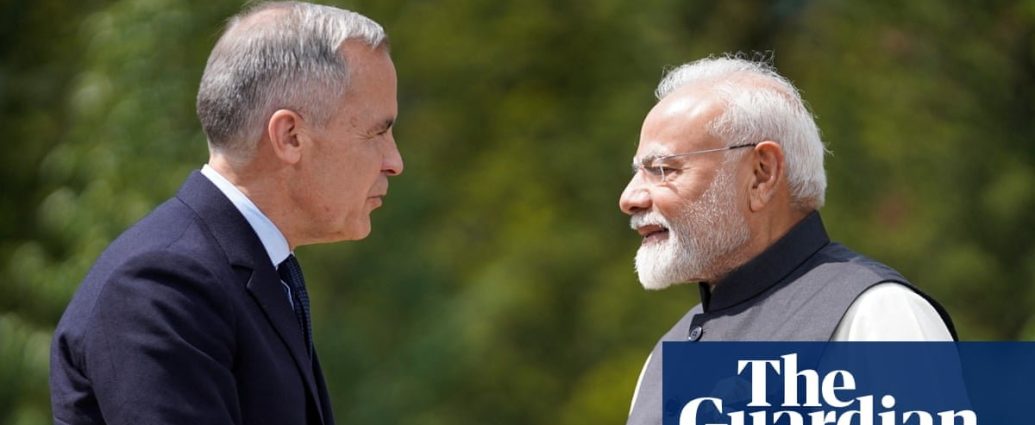
Mark Carney landed in Delhi this morning for what could be the biggest diplomatic roll of the dice he’s made since becoming prime minister. After more than a year of these two countries basically screaming at each other about murder plots and terrorism accusations, the leaders are sitting down today to act like none of that ever happened.
The whole thing is pretty wild if you think about it.
Just months back, Canada and India were kicking each other’s diplomats out and making nasty public accusations. Now Carney’s gambling that both countries being fed up with Donald Trump’s America can somehow make all that drama disappear.
Following the Money Trail
Right now, trade between Canada and India barely hits C$15 billion. That’s basically nothing compared to our US trade, which smashed $903 billion last year, but Carney wants to flip that script fast. He’s promised to double Canada’s non-US exports over the next ten years, and India’s 1.4 billion people? That’s his best shot at making those numbers work.
There’s apparently real buzz around a 10-year uranium deal worth US$2.8 billion.
That’s exactly the kind of solid win Carney needs to prove this diplomatic do-over isn’t just for show (to put it lightly). Canada sits on about 13% of global uranium reserves, and India’s planning to triple its nuclear capacity by 2032.
When you crunch the demographics, the potential here is massive.
India’s GDP jumped 7.6% in Q2 2024, making it the fastest-growing big economy on the planet. Canada’s puttering along at 2.1% growth. You can see why Carney’s practically drooling over this partnership.
“India is the most populous country in the world right now and by most accounts the fastest growing big economy in the world. It’s a tremendous country to hitch your wagon to,” said Partha Mohanram, director of the India Innovation Institute at the University of Toronto.
Mohanram’s got a point. Most wealthy countries are dealing with flat demographics and slow growth, but India’s economy is exploding. Canada’s energy exports could tap into a huge new market just as our neighbour to the south gets increasingly sketchy. India bought $240 billion worth of crude in 2023, mostly from Russia and the Middle East. Canada wants in on that.
When Everything Went Sideways
To get why today’s meeting matters, you’ve got to go back to September 2023.
That’s when everything blew up (and that’s putting it mildly). Carney’s predecessor Justin Trudeau got up in Parliament and flat-out accused India of killing Hardeep Singh Nijjar, a Canadian Sikh activist, right here on Canadian soil in Surrey, BC.
The response was swift and brutal.
India booted 41 Canadian diplomats in October 2023, leaving Canada with just 21 diplomatic staff in the entire country.
Canada pulled most of its people out too. Trade talks that’d been dragging on since 2010? Gone. Cultural exchanges stopped cold. Student visas slowed to a crawl.
But that wasn’t the end of it. Canadian police came out in October 2024 claiming Indian government agents were running “widespread violence” operations – murders, extortion, intimidation of Canadian citizens.
India called it all “preposterous” and shot back that Canada was harboring terrorists.
By November 2024, things couldn’t get much worse.
India’s foreign ministry was openly questioning whether Canada gave a damn about fighting terrorism. Canadian officials kept talking about “credible allegations” of Indian state involvement in criminal stuff happening on Canadian turf.
Why They Need Each Other Now
The timing of this visit? It’s no accident. Both Canada and India have managed to tick off Trump, which creates what Mohanram calls a “misery loves company” situation. India recently smoothed things over with the US after fights about market access and their massive Russian oil purchases, but nobody’s betting that’ll last.
Trump’s trade war approach has both countries on edge. Last time he was president, he slapped tariffs on Canadian steel and aluminum, literally calling Canada a “national security threat.” This time around, he’s threatening 25% tariffs on everything Canadian, which would absolutely wreck an economy where 77% of exports head south.
India’s got its own Trump problems brewing. They imported $87.4 billion worth of Russian crude in 2023, making them Moscow’s biggest oil customer after China. Trump’s people have already signaled they’re not thrilled about India’s continued energy romance with Russia.
Canada’s position is even shakier. Despite having the world’s largest undefended border and one of the most connected economies anywhere, Trump keeps bullying Canada on trade. Carney’s answer has been to actively look elsewhere – hence the sudden interest in places like India and China.
The energy angle just makes sense. India imports massive amounts of energy. Canada exports it. As global supply chains get more political by the day, having solid partners outside the US bubble becomes gold. Canada shipped out $189 billion in energy products in 2023, with 89% going to the States. Carney wants to change that math.
“Misery loves company. Both countries can share the feeling of being ill-treated by the US,” said Mohanram. “But there are also strengths in looking at each other. India is a massive importer of energy. Canada is a massive exporter of energy. Right now, that makes Canada very attractive to India.”
From Train Wreck to Business Deal
The difference from earlier visits is night and day.
Trudeau’s 2018 India trip was a complete disaster – they even had a convicted Sikh separatist at official events. The Indian government gave Trudeau what everyone saw as a deliberately icy reception. Modi looked uncomfortable in every photo, and the lack of real agreements said everything.
Jump to June 2025, and Carney was all smiles with Modi at the G7 in Kananaskis, Alberta. The body language told a totally different story this time. Both leaders were grinning, shaking hands, doing what diplomats call “productive dialogue.” Going from hostile accusations to friendly cooperation in six months? That’s pretty remarkable.
This time around, India’s High Commissioner to Canada Dinesh Patnaik is framing the whole visit as pure business.
The message couldn’t be clearer: both sides want to move past last year’s diplomatic mess and focus on making money. The groundwork for this reset has been happening quietly since January.
Before Delhi, Carney and his team met with business leaders in Mumbai on Sunday.
That’s the signal this trip is about cash, not diplomatic pleasantries. The Mumbai meetings included reps from India’s biggest companies – Reliance Industries and Tata Group – both interested in Canadian energy investments.
The Bigger Strategy Picture
This India visit is the second major diplomatic push in Carney’s don’t-put-all-your-eggs-in-one-basket strategy. Back in January, he took a delegation to China trying to reset things with Beijing. That trip netted $4.2 billion in preliminary trade deals, mostly agriculture and natural resources.
Not ideal.
The pattern’s obvious: Canada’s actively shopping around for alternatives to US trade dependence. Carney spends half his time talking about restructuring political and economic relationships because international institutions are crumbling and alliances keep shifting. That “rupture in the world order” he mentions constantly isn’t just fancy talk – it’s driving actual policy.
Canada’s Indo-Pacific strategy from November 2022 committed $2.3 billion over five years for deeper regional engagement. India got specifically tagged as a key trading partner, with predictions that bilateral trade could hit $50 billion by 2035 if the right deals get done.
Question is whether today’s meeting can turn that strategic thinking into actual agreements. The uranium deal would be a solid start, but both countries are eyeing much broader collaboration in energy, tech, and education. Canadian pension funds are particularly interested in India’s infrastructure boom, which needs $4.5 trillion in investment through 2030.
What This Actually Means for Regular People
For everyday Canadians, this diplomatic reset could hit their lives pretty directly. Education’s probably where you’ll feel it first. Before everything went sideways, Indian students made up the biggest chunk of international students here – over 320,000 enrolled in 2023. That number dropped 35% in 2024 as visa processing crawled and relations soured.
A successful reset means those numbers bounce back fast, bringing billions to Canadian universities and communities. International students pump about $22 billion annually into Canada’s economy, with Indian students accounting for roughly 40% of that.
The job market implications are huge too.
Canada’s tech sector has been struggling with talent shortages, and Indian graduates have historically filled many gaps. Companies like Shopify, BlackBerry, and Bombardier have hired tons of Indian graduates from Canadian schools.
Energy workers in Alberta and Saskatchewan are watching this visit closely.
India’s growing energy appetite could mean long-term contracts for Canadian oil, gas, and uranium. That proposed uranium deal alone could support 2,800 jobs in Saskatchewan’s mining sector over the next decade.
Immigration’s another area where regular Canadians will notice changes. India consistently ranks as the top source for new permanent residents to Canada – about 118,000 new immigrants in 2023. Better diplomatic relations usually mean faster processing and expanded programs.
What’s Really on the Line Here
For Carney, this visit is about proving Canada can build serious economic relationships outside North America. The domestic politics are massive.
If he can show real progress on trade diversification, it strengthens his position for future US negotiations. Carney’s approval ratings have been stuck around 42% since taking office, and a foreign policy win could give his government the boost it needs.
For Modi, the math is different but equally important.
Modi’s government has been positioning India as a reliable alternative to China for Western countries diversifying supply chains. A successful Canada partnership could be a template for similar deals with other middle powers. Modi’s facing his own domestic heat – inflation at 5.7% and youth unemployment hitting 17.8%.
The education piece can’t be ignored either.
Canadian universities are signing partnerships with Indian schools during this visit, potentially creating long-term people-to-people connections beyond government relations. The University of Toronto just announced a $45 million research collaboration with the Indian Institute of Technology during Carney’s visit.
Both leaders are betting that shared frustration with American unpredictability can overcome the serious diplomatic baggage between their countries.
It’s a risky move, but with global trade relationships getting shakier by the day, both Canada and India might’ve decided they need every reliable partner they can find. The next 48 hours will show whether this diplomatic reset is legit or just another photo-op that goes nowhere.
Frequently Asked Questions
What trade deals are Canada and India discussing?
The main focus is a 10-year uranium supply deal worth US$2.8 billion, along with broader energy and education partnerships.
Why is Canada pursuing stronger ties with India now?
Carney wants to double Canada’s non-US exports within a decade to reduce dependence on increasingly unpredictable American trade policies.
How much trade currently exists between Canada and India?
Current trade between the two countries is valued at less than C$15 billion, which both sides see as having huge potential for growth.