
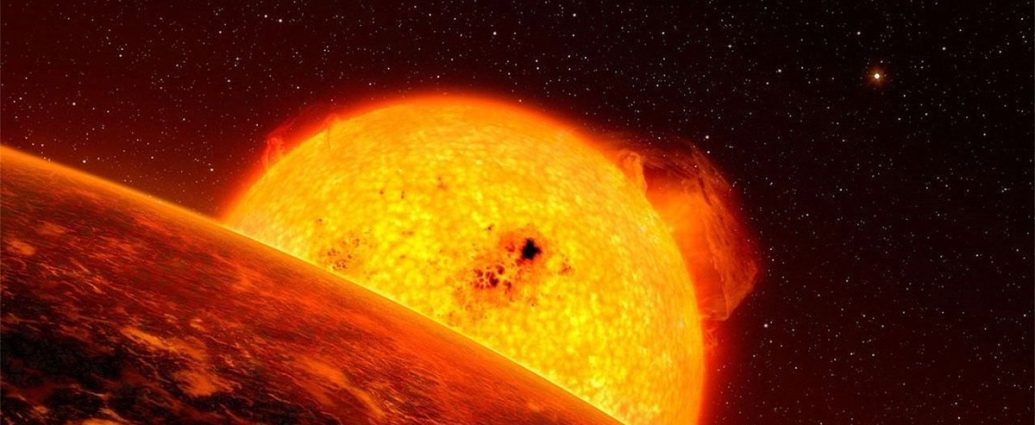
Canadian astronomers just cracked something that’s been making scientists pull their hair out for fifty years. They figured out how red giant stars shuffle stuff from way down in their cores all the way up to their surfaces.
University of Victoria’s Astronomy Research Centre nailed it.
They ran these incredible 3D simulations on supercomputers. The answer? Rotation does it all.
This wraps up a puzzle from the 1970s when astronomers first spotted these bizarre chemical changes in old stars. Decades of research and millions of dollars later, nobody could explain how it happened until February 2026.
The Thing That’s Been Making Scientists Go Crazy Since the ’70s
Here’s what goes down. Stars like our Sun age and balloon into red giants, getting several times bigger than they started. Scientists have been watching this forever and noticed something really weird back in the 1970s.
Surface chemistry gets all mixed up. That carbon-12 to carbon-13 ratio drops. The only way you get that’s if stuff from way deep inside somehow crosses this stable barrier and makes it to the surface.
But how’s that material getting shuffled around?
Look, stars aren’t just big burning balls floating in space. They’ve got layers. There’s the core where all the fusion’s happening, then this stable barrier thing, then the outer part. That barrier’s supposed to keep everything separated.
Red giants make up about 13% of stars you can actually see without a telescope.
Understanding how they work isn’t just some academic thing. It’s essential for figuring out how stars change across the whole universe. Earlier attempts used basic models that couldn’t catch those complicated 3D movements happening inside stars. These old simulations said maybe internal gravity waves were moving material across the barrier, but they showed transport rates way too slow to match what we’re actually seeing.
“Using high-resolution 3D simulations, we were able to identify the impact that the rotation of these stars was having on the ability for elements to cross the barrier,” said Simon Blouin, the University of Victoria postdoctoral fellow who ran the research.
Stellar rotation is important and provides a natural explanation for the observed chemical signatures in typical red giants.
What These Monster Computers Found
The team used two massive supercomputing setups.
One’s at the Texas Advanced Computing Centre in Austin. The other was that brand new Trillium cluster at SciNet in Toronto. That Trillium thing cost $60 million CAD and cranks out 3.2 petaFLOPS of calculations per second. That’s 3.2 quadrillion floating-point operations every single second. To put that in perspective, someone with a calculator would need about 100 billion years to do what Trillium spits out in one second.
Previous simulations showed waves could get across the barrier, but they barely moved any material.
Those older models were stuck because of limited computing power. Not this time.
“We were able to discover a new stellar mixing process only because of the immense computing power of the new Trillium machine,” said Falk Herwig, who runs the Astronomy Research Centre and led the whole project.
These simulations allow us to tease out small effects to determine what actually happens, helping us to understand our observations. We were able to discover a new stellar mixing process only because of the immense computing power of the new Trillium machine.
The results were wild. Stellar rotation bumps up mixing rates by over 100 times compared to stars that aren’t spinning. Faster rotation means even more mixing. The simulations showed that spinning red giants create internal gravity waves that get way more effective at moving material around. In some cases, mixing efficiency jumped by factors of 200 to 300 times when rotation speeds hit what we typically see.
What’s Actually Going On Inside These Things
The breakthrough’s all about how rotation messes with internal gravity waves in red giant stars.
These waves happen when hot, light material tries to rise through that stable barrier layer between the core and outer part. In a star that’s not spinning, these waves don’t carry much material. But rotation flips everything. It makes what researchers call “wave resonances” that boost the transport of chemical elements across the barrier by more than two orders of magnitude.
The team’s simulations followed individual chunks of stellar material as they moved through the star’s insides over months to years. They found rotation creates this conveyor belt system, where waves keep ferrying material from the interior to the surface.
Here’s how it works: nuclear fusion in the core makes carbon-13 from carbon-12.
In a star that’s not spinning, this stuff stays stuck near the core. But rotation-driven waves carry it outward, eventually hitting the surface and changing those carbon isotope ratios we observe. The discovery doesn’t just explain red giants. It also helps astronomers understand how other types of evolved stars mix their insides. Same physics probably applies to stars across a wide range of masses and ages.
What’s Gonna Happen to Our Sun
This research gives us a detailed preview of what happens to our Sun in about 5 billion years.
When it runs out of hydrogen fuel, it’ll expand into a red giant and probably swallow Mercury, Venus, and maybe Earth. During that red giant phase, our Sun will expand to roughly 256 times its current size. That’s big enough to eat everything out to about Earth’s current orbit. What happens to Earth exactly isn’t clear, but the planet will definitely become unliveable as surface temperatures shoot past 1,000 degrees Celsius.
The new research shows that during this expansion phase, which’ll last about 1 billion years, the Sun will experience the same rotation-driven mixing that the team saw in their simulations.
This mixing will change the Sun’s surface chemistry in ways we can predict. During that phase, the habitable zone will move outward. Objects beyond what we call the Frost Line today could end up in a zone where liquid water exists. Think moons of Jupiter and Saturn.
Europa and Enceladus, currently frozen moons with subsurface oceans, might develop surface oceans when they enter the Sun’s expanded habitable zone.
But honestly, that’s a problem for future civilizations to worry about. The Sun’s red giant phase will also strip away much of its outer atmosphere, eventually leaving behind a white dwarf star about the size of Earth but containing most of the Sun’s current mass. This white dwarf will slowly cool over trillions of years.
Why This Changes Everything We Know About Stars
This discovery forces astronomers to rewrite textbooks on stellar evolution.
For decades, models assumed that material mixing in red giants happened through poorly understood “extra mixing” processes that had to be added by hand to make theoretical predictions match observations. The new research shows rotation-driven mixing is a natural consequence of stellar physics. No extra assumptions needed.
This simplifies stellar evolution models and makes them more predictive.
The implications extend way beyond red giants. Same physics probably affects other evolved stars, including asymptotic giant branch stars that produce much of the carbon and nitrogen in the universe. The discovery also helps explain puzzling observations of red giants in globular clusters. These ancient star clusters contain thousands of red giants that show unexpected chemical variations. The new mixing mechanism could account for at least some of these differences.
For stellar archaeologists who study the oldest stars in our galaxy, this research provides new tools for interpreting chemical signatures. Surface compositions of ancient red giants contain information about the early universe, but only if we understand how stellar mixing affects what we observe.
This Goes Way Beyond Just Stars
Here’s where it gets really wild.
The computational techniques they developed don’t just apply to stars. Same methods could help researchers study ocean currents, atmospheric dynamics, even blood flow in the human body. Mathematical equations that govern fluid flow are similar whether you’re modeling stellar interiors, ocean circulation, or air movement in the atmosphere. The team’s advances in simulating rotating fluids with internal waves have applications across multiple fields.
Herwig’s already working with scientists in climate research, ocean monitoring, and medicine to adapt these simulation methods.
Applications could benefit everything from weather prediction to medical treatments. In oceanography, the techniques could improve models of deep ocean circulation that drive global climate patterns. Same internal gravity waves that transport material in stars also move heat and nutrients through Earth’s oceans. Climate scientists are particularly interested in how the methods could improve understanding of atmospheric mixing. The interaction between rotation and internal waves affects everything from storm formation to the transport of greenhouse gases.
Medical researchers see potential applications in modeling blood flow through arteries and veins. Same fluid dynamics principles apply, though at vastly different scales and conditions.
Worth noting: this represents the most computationally intensive stellar convection and internal gravity wave simulations performed to date. We’re talking about modeling the movement of material inside a star with unprecedented detail.
Canada’s Massive Investment in Science
The research was supported by Canada’s Natural Sciences and Engineering Research Council, along with the National Science Foundation and US Department of Energy.
Total funding for the project exceeded $2.1 million CAD over four years. It shows what happens when Canadian researchers get access to world-class computing resources. The Trillium supercomputer at the University of Toronto was key to the breakthrough. Without that level of computing power, the team couldn’t have run simulations detailed enough to capture the small effects that actually matter.
Canada’s investment in high-performance computing infrastructure is really paying off.
The Trillium system, installed in late 2025, ranks among the top 50 supercomputers globally. It serves researchers across the country, from astronomy to artificial intelligence to drug discovery. University of Victoria’s Astronomy Research Centre has become a world leader in computational astrophysics largely because of access to these resources. The centre now attracts top researchers from around the globe who want to tackle problems that require massive computational power.
“These simulations allow us to tease out small effects to determine what actually happens, helping us to understand our observations,” Herwig explained.
Project also highlights how important international collaboration is in modern science.
While Canadian institutions led the research, partnerships with American universities and computing centres were essential for success.
What This Actually Means for Regular Canadians
This discovery puts Canadian astronomy research on the world map in a huge way. University of Victoria’s Astronomy Research Centre is now recognized as a global leader in computational stellar physics, attracting international students and researchers.
But the economic impact goes way beyond just academia.
High-performance computing skills developed through projects like this create highly skilled workers who find employment in sectors ranging from finance to artificial intelligence to climate modeling. Several graduate students who worked on the project have already been recruited by tech companies and research institutions across North America. Computational techniques they learned have applications far beyond astronomy.
For Canada’s space industry, understanding stellar evolution helps with everything from satellite design to space weather prediction.
Solar activity affects communication satellites, GPS systems, and power grids. Better models of stellar behaviour improve our ability to predict and mitigate these effects. Research also strengthens Canada’s position in international space collaborations. Canadian Space Agency contributes to major telescope projects that study stellar evolution, and discoveries like this one increase Canada’s scientific credibility and influence.
Educational benefits flow to Canadian students at all levels.
Visualization techniques developed for the stellar simulations are being adapted for high school physics classes, helping students understand complex concepts through interactive computer models.
Where Things Go Next
Blouin plans to keep using these techniques to study other aspects of stellar evolution. Methods they’ve developed could help solve other long-standing puzzles about how stars actually work.
Team’s next target is understanding how rotation affects mixing in even more massive stars that eventually explode as supernovae.
These explosions distribute heavy elements throughout galaxies, so understanding their internal mixing processes has implications for the chemical evolution of the universe. They’re also planning to study how magnetic fields interact with rotation-driven mixing. Many red giants have strong magnetic fields that could either enhance or suppress the transport processes they’ve discovered.
A major expansion of the research is scheduled for 2027, when the team gains access to Canada’s next-generation exascale computing system.
This machine will be roughly 100 times more powerful than current systems, allowing simulations that follow stellar evolution over much longer timescales. Long-term goal is to create a complete 3D model of how stars like the Sun evolve from birth to death. Such models would help astronomers understand not just individual stars, but entire populations of stars in galaxies across the universe.
If you’re wondering why this matters beyond pure science, remember that understanding stellar evolution helps us understand the origins of the elements that make up planets and life itself.
Every element heavier than hydrogen and helium was forged inside a star. Mixing processes they’ve identified help explain how those elements get distributed throughout the universe. That includes the carbon, oxygen, and iron that make up our planet and our bodies.
This discovery is another step forward in understanding how stars evolve and how they create and distribute the building blocks of worlds like ours.
It also demonstrates that some of the biggest questions in science require the biggest computers to answer.
Frequently Asked Questions
What are red giant stars?
Red giant stars are what happens when stars like our Sun reach the end of their main sequence and expand to several times their original size.
Why couldn’t scientists explain the chemical mixing before?
Previous computer simulations lacked the processing power to model the complex 3D movements inside stars with enough detail to see how rotation affects mixing.
When will our Sun become a red giant?
Our Sun will become a red giant in about 5 billion years when it exhausts its hydrogen fuel supply.