
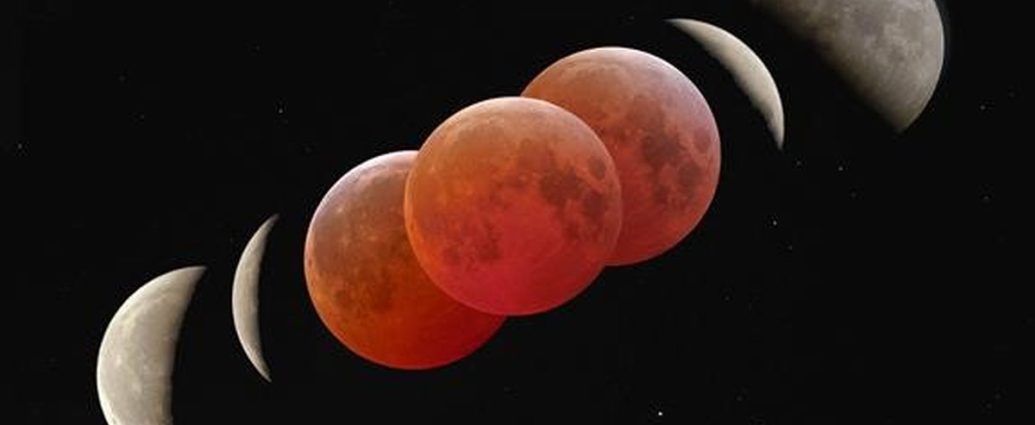
Set those alarms now. A total lunar eclipse is about to paint the Moon blood red across Canadian skies early Tuesday morning, and it’s worth losing sleep over if you can drag yourself out of bed before sunrise.
The show kicks off around 6:04 a.m. Eastern Time on March 3rd. If you’re stuck in Quebec City, you’ve got exactly 14 minutes to catch this thing before the Moon disappears and morning light kills the view.
Thing is, lunar eclipses don’t give a damn about your sleep schedule.
Here’s What’s Really Going On
Philippe Moussette runs the Véga de Cap-Rouge astronomy club, and he explains it pretty simply. Earth basically photobombs the Sun and Moon during a total lunar eclipse. Our planet slides right between them, and the Moon gets swallowed up by Earth’s shadow.
“This means that the only light that will be sent to the moon is the light that’s filtered through the atmosphere. That’s why the moon will turn reddish,” Moussette explains.
That filtering trick is exactly why we call it a Blood Moon. Earth’s atmosphere bends red light around our planet like some cosmic prism, washing the Moon in this creepy copper glow.
Scientists call this Rayleigh scattering – same reason sunsets look red and the sky’s blue.
Good news: you can look right at this one. No fancy glasses required. Binoculars make it way better, but your eyes alone will do the job just fine.
The Moon’s also gonna look about 14% bigger than usual since it’s getting close to perigee – that’s the nearest point in its wonky orbit around Earth. During totality, the Moon won’t just vanish.
Instead, it turns into this glowing ball that ranges from bright orange to deep red, depending on how much junk is floating in our atmosphere. Dust, volcanic ash, smog – it all changes the colour.
When to Wake Up (Or Stay Up)
The Canadian Space Agency’s got the schedule nailed down. Totality peaks at 7:04 a.m.
Atlantic Time, 6:04 a.m. Eastern, and 3:04 a.m. Pacific Time. The whole thing takes about 5 hours and 18 minutes from start to finish.
But here’s the kicker. Where you live basically determines whether you get an amazing show or a frustrating tease.
Quebec City folks are getting screwed on this one. Total eclipse starts at 6:03 a.m. But the Moon sets at 6:17 a.m. That’s barely enough time to stumble outside with your coffee.
“For people in Quebec, the further west you are, the better. For people in Quebec City, for example, the total eclipse will begin at 6:03 a.m. But the moon will set at 6:17 a.m. So, obviously, we won’t have much time to see it, and we’ll see an area that’s almost in broad daylight,” Moussette warns.
Montreal gets an extra 8 minutes. Ottawa scores a decent 23-minute window. But Vancouver? You’ve hit the jackpot with prime viewing in proper darkness and over an hour to watch everything unfold.
The whole show begins with what astronomers call the penumbral phase at 3:02 a.m. Pacific Time – that’s when Earth’s fuzzy outer shadow starts touching the Moon. Partial eclipse kicks in at 4:09 a.m. Pacific, with totality running from 5:26 a.m. To 6:41 a.m.
Pacific Time.
How Each Province Fares
Atlantic Canada’s watching this during morning twilight, which isn’t ideal. Newfoundland and Labrador see totality start at 8:33 a.m. Local time, but moonset happens around 8:45 a.m. Just 12 minutes in brightening skies.
New Brunswick and Nova Scotia get slightly better deals – roughly 18-20 minutes of totality before the Moon disappears. Prince Edward Island falls somewhere in the middle.
Ontario and Quebec are racing against sunrise. Eastern chunks of these provinces will watch the Moon set while it’s still eclipsed. Toronto gets about 35 minutes of totality before moonset at 6:52 a.m. Sudbury and Thunder Bay? Much better luck with the Moon staying visible the whole time.
The Prairies absolutely win on this one. Winnipeg, Regina, Saskatoon, Calgary, Edmonton – they all get the complete eclipse in dark pre-dawn skies. Moon stays 15-25 degrees above the western horizon throughout totality.
British Columbia’s getting the VIP treatment. Vancouver, Victoria, Kamloops – the Moon sits 35-40 degrees up during totality. Perfect darkness, no dawn interference.
Why We Don’t Get These Monthly
You’d figure lunar eclipses would happen every month, right? I mean, we get a full moon every 29.5 days. But the Moon’s orbit is tilted about 5.1 degrees compared to Earth’s path around the Sun.
Interesting timing, to say the least.
Most full moons pass slightly above or below Earth’s shadow. You need perfect alignment when the Moon crosses that orbital plane at the exact moment it’s full.
These crossing points line up with the Sun and Earth just twice yearly during eclipse seasons.
The numbers break down like this: we average 2.4 lunar eclipses per year, though some years deliver up to five. Total eclipses like Tuesday’s make up exactly 37.3 percent of all lunar eclipse events. Partial eclipses are 34.5 percent, penumbral eclipses account for 28.2 percent.
Last total lunar eclipse Canadians could see was May 26, 2021, though western provinces had way better conditions (for better or worse). Before that, we caught totality on January 21, 2019, and July 27, 2018.
Hour-by-Hour Breakdown
Five distinct stages make up this eclipse, each delivering different visuals. Knowing the timeline helps you figure out when to step outside and what you’ll actually see.
First up, Earth’s fuzzy outer shadow starts nibbling the Moon’s edge during the penumbral phase.
Begins at 4:02 a.m. Eastern Time, but honestly? Pretty subtle stuff. You’ll notice slight dimming on one side, like someone’s messing with a dimmer switch.
Real action starts at 5:09 a.m. Eastern when the Moon hits Earth’s darker inner shadow – the umbra.
That’s when you get that classic bite-shaped shadow creeping across the lunar surface. Shadow moves at roughly 1,500 kilometers per hour, taking 62 minutes to completely swallow the Moon.
Totality kicks in at 6:26 a.m. Eastern Time, running 65 minutes until 7:31 a.m.
Eastern. During this stretch, the entire Moon glows that famous blood red. Shade varies depending on what’s floating in Earth’s atmosphere around the terminator line – that’s where day meets night.
Volcanic ash, dust storms, heavy cloud cover – all that junk can deepen the red or throw in orange and yellow tints. This March eclipse should deliver classic red-orange since no major volcanoes have blown recently to mess up our atmosphere.
Some eclipses give you a bright copper Moon that cuts through suburban light pollution.
Others go dark brown or nearly vanish completely. The 1816 eclipse was so dark astronomers lost sight of the Moon entirely because of ash from Mount Tambora.
After totality ends, everything reverses. Partial eclipse continues until 8:34 a.m. Eastern, then the final penumbral phase wraps at 9:41 a.m. Eastern. By then, daylight makes the Moon impossible to spot from eastern Canada.
What It Means for Regular Folks
Beyond the cool factor, this eclipse’s got real impacts across Canada (for better or worse). Astronomical tourism gets a serious boost during eclipse events – hotels in western provinces are seeing 15-20% occupancy bumps for eclipse nights.
Amateur astronomy clubs have organized 47 public viewing events countrywide. These gatherings typically pull 200-500 people each, introducing thousands of Canadians to stargazing as a hobby.
Timing creates headaches for morning commuters, especially in western cities where totality happens during rush hour prep time. Vancouver transit folks expect slight delays as people stop to snap photos.
Schools are working the eclipse into science classes. UBC’s astronomy department scheduled special observation sessions for students, while Alberta elementary schools are shifting start times so teachers and kids can witness totality.
Indigenous communities across Canada view lunar eclipses through traditional knowledge systems. Many First Nations consider eclipses powerful spiritual events requiring specific protocols and ceremonies. Early spring timing holds particular meaning in many traditions.
Wildlife gets weird during lunar eclipses too. Canadian researchers at several universities are studying how nocturnal animals react to sudden darkness and light changes. Previous eclipses showed owls becoming more active while some mammals got confused about sleep cycles.
How to Actually Watch This Thing
Find a spot with clear western sky. The Moon’s setting in that direction during the eclipse. Trees, buildings, hills – they’ll all block your view. Urban parks, lakeshores, open fields work best.
Check weather 48 hours ahead. Environment Canada’s predicting partly cloudy across southern Ontario and Quebec, clearer skies in the Prairies.
Go figure.
BC faces typical March cloud cover on the coast, but interior regions should have excellent visibility.
Bundle up. Early March mornings still hit temperatures between -10°C and 5°C across most of Canada. You’ll be outside at least 30 minutes for the full experience.
Layers beat heavy coats since you’ll want to move around.
Bring a chair or blanket. Craning your neck upward for extended periods sucks fast.
The Moon sits 20-45 degrees above the horizon depending on location, so you’ll want comfortable viewing angles.
If you’re serious about this, grab binoculars or a small telescope. The eclipse looks spectacular through 7×50 or 10×50 binoculars, showing details you can’t see with naked eyes. Telescopes with 4-8 inch apertures reveal individual craters and mountain ranges during totality.
Phone Photos Won’t Cut It
Your smartphone can capture the eclipse, but don’t expect stunning results. Phone cameras struggle with low light and the Moon’s tiny apparent size – just 0.5 degrees of sky.
DSLR or mirrorless camera with 200mm or longer telephoto lens works much better.
Start with ISO 800-1600, f/8 aperture, experiment with shutter speeds between 1/60th and 2 seconds. During totality, you’ll need longer exposures of 2-8 seconds.
Use a sturdy tripod and remote shutter to avoid shake. Manual focus beats autofocus in low light. Take test shots of the normal full moon beforehand to dial in settings.
But honestly? Just watch it. Photos can wait. Too many people experience eclipses through camera screens instead of witnessing the actual event.
When’s the Next One?
Miss Tuesday’s show? You’ll get another chance.
But you’re waiting a while. Next total lunar eclipse visible from Canada won’t happen until October 8, 2028, and viewing conditions will favor western provinces again. After 2028, Canadians wait until March 14, 2032. That one happens during evening hours, making it way more convenient.
Moon will be high in the sky with totality around 9:30 p.m. Eastern Time.
Partial lunar eclipses are more frequent, but they lack the dramatic colour that makes total eclipses special. Next partial eclipse visible from Canada happens September 18, 2024, followed by another March 14, 2025.
European observers get better eclipse timing over the next decade, with several totals during convenient evening hours. But Canadians near major population centers won’t see another well-positioned total lunar eclipse until the 2030s.
Look, Tuesday morning isn’t exactly convenient timing. Early March temperatures and pre-dawn darkness don’t scream “fun outdoor activity.” But lunar eclipses are rare enough that missing this means waiting years for the next shot. Set that alarm.
Astronomy folks estimate any given location sees a total lunar eclipse about once every 2.5 years on average. But viewing conditions, weather, and timing mean the practical gap between good eclipses often stretches to 3-5 years or longer.
For Canadian eclipse chasers, Tuesday represents the best viewing opportunity until 2032. That’s six years between convenient total lunar eclipses visible from our major population centers.
Weather permitting, bundle up and step outside. Your future self will thank you for making the effort.
Frequently Asked Questions
What time is the blood moon eclipse in Canada?
The eclipse peaks at 6:04 a.m. Eastern Time, 7:04 a.m. Atlantic Time, and 3:04 a.m. Pacific Time on March 3rd.
Why does the Moon turn red during an eclipse?
Earth’s atmosphere filters sunlight, bending red wavelengths around our planet and casting a reddish glow on the Moon.
Can you look directly at a lunar eclipse?
Yes, lunar eclipses are completely safe to view with the naked eye or through binoculars, unlike solar eclipses.