
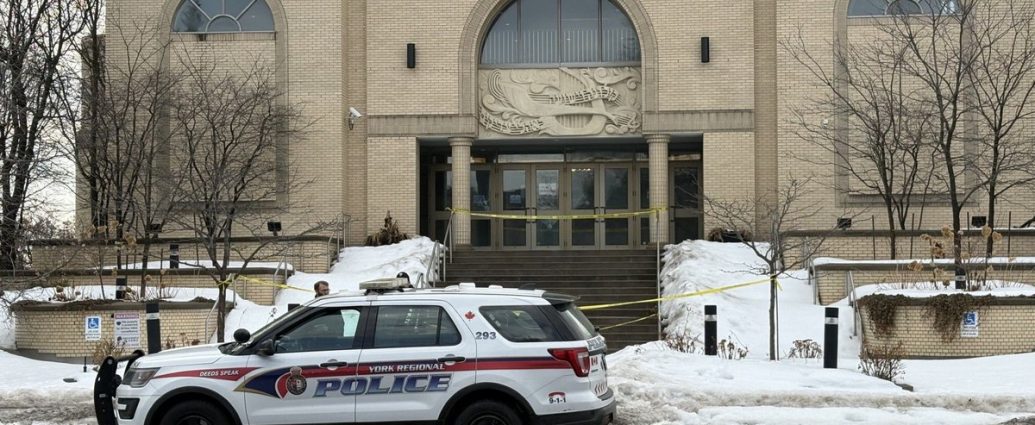
Three bullets through the windows of a Thornhill synagogue this morning (shocking, I know). That’s the third Jewish place of worship hit by gunfire in the Toronto area in just one week.
The latest shooting happened at Kehillat Shaarei Torah on Atkinson Avenue around 3:15 AM, shattering three large front windows and leaving bullet holes in the building’s limestone facade. Nobody was inside when the shots rang out, but the message was clear enough. This makes it the third synagogue targeted with gunfire since February 28th, marking what police are now calling an unprecedented wave of antisemitic violence in the Greater Toronto Area.
Damage to the Thornhill synagogue alone exceeds $8,000, preliminary insurance assessments show. But the psychological impact on Toronto’s 188,000-strong Jewish community? You can’t put a price on that.
- Three synagogues targeted with gunfire in eight days
- Latest incident: Kehillat Shaarei Torah in Thornhill at 3:15 AM
- Total estimated damage: $24,000 across all three locations
- No injuries reported in any incidents
- Police treating attacks as coordinated hate crimes
- Jewish community leaders calling for increased security funding
This Isn’t Random Violence
We’re not looking at random vandalism here. This is a coordinated pattern of attacks specifically targeting Jewish institutions across the Greater Toronto Area, each incident showing signs of advance planning and reconnaissance.
First incident hit Congregation Beth David in North York on February 28th at 2:45 AM. Five shots fired, three windows destroyed, damage estimated at $6,500. Then Beth Tikvah Synagogue in Etobicoke on March 3rd at 3:30 AM. Four shots, two windows shattered, $9,500 in damage.
Now Thornhill. The timing pattern alone suggests someone who’s familiar with synagogue schedules and security routines. Someone who’s been watching.
York Regional Police arrived at the Kehillat Shaarei Torah synagogue at 3:42 AM to find bullet holes in the front windows and nine-millimeter shell casings scattered on the sidewalk. The building’s newly installed security cameras caught footage of a dark sedan, possibly a Honda Civic, speeding northbound on Atkinson Avenue at 3:17 AM.
Ballistics experts pulled bullet fragments from inside the synagogue’s main sanctuary, where 150 people gathered just last Friday night for Shabbat services. The bullets travelled approximately 40 feet into the building before embedding in wooden pews that’ve served the congregation since 1998.
“This is a hateful and antisemitic act that has no place in our community. We won’t tolerate this violence against any faith group,” Vaughan Mayor Steven Del Duca said in a statement released at 2:30 PM.
Del Duca’s response came quickly, but the Jewish community’s asking what took so long for authorities to connect these dots. Three synagogues, three shootings, eight days. The pattern was obvious after the second incident.
What This Means Going Forward
These attacks represent a sharp escalation from the graffiti and verbal harassment that Toronto’s Jewish institutions have endured for months. This is the first time in the city’s modern history that multiple synagogues have been targeted with gunfire in such rapid succession.
Fear Hits Home
Rabbi Michael Goldstein, who’s led the 400-family congregation at Kehillat Shaarei Torah for 12 years, says his community’s shaken but determined not to be intimidated. They’ve been dealing with increased antisemitic incidents since October 2023, spending $4,200 on new security cameras just two months ago.
“We’ve had swastika graffiti four times since December, threatening phone calls twice a week, people driving by shouting slurs during our children’s programs,” Goldstein told reporters outside the damaged building at 11 AM. “But this represents a dangerous escalation. These are bullets flying through our windows where 85 children come to learn Hebrew on Sunday mornings.”
The synagogue’s Hebrew school program serves families from across York Region, with students ranging from ages 4 to 16. Many parents were already expressing concerns about safety after incidents at other Jewish institutions.
Now those fears have literally hit home.
Board president Ruth Kellerman says the congregation held an emergency meeting at 7 PM yesterday with 75 families attending via Zoom. The main topics: immediate security upgrades and whether to cancel this weekend’s events.
“We have a bar mitzvah scheduled for Saturday morning,” Kellerman explains. “Thirteen-year-old David Rosen has been preparing for two years. His family’s asking whether it’s safe to proceed.”
That’s a question no family should have to ask.
The financial burden of increased security is hitting smaller congregations particularly hard. Temple Shalom in Richmond Hill, which serves 180 families, estimates it’ll need $22,000 for security upgrades including bulletproof film for windows, reinforced doors, and a professional monitoring system.
“We’re a community built on faith and openness. Having to fortress our sacred spaces goes against everything we believe in, but we don’t have a choice,” says Rabbi Sarah Goldberg of Temple Shalom.
The Investigation Expands
Toronto Police Service, York Regional Police, and now the RCMP are coordinating what’s become the largest hate crime investigation in the GTA’s recent history. The Joint Hate Crime Investigation Task Force was activated at 10 AM today, bringing together 15 detectives and analysts.
Detective Inspector Sarah Chen, who’s leading the Toronto portion of the investigation, confirmed they’re examining ballistics evidence from all three scenes. Preliminary analysis suggests the same weapon was used in at least two of the attacks, though final lab results won’t be available until next week.
“We’re treating this as a series of coordinated attacks against the Jewish community. We have dedicated 12 officers specifically to this investigation and we’re working with federal partners to examine any potential connections to extremist networks,” Chen said during a 4 PM news conference at Toronto Police headquarters.
The task force has established a dedicated tip line (416-808-HATE) and they’re offering a $50,000 reward for information leading to arrests. They’re also reviewing surveillance footage from gas stations, traffic cameras, and businesses within a two-kilometre radius of each synagogue.
Digital forensics specialists are examining social media posts and online forums for potential threats against Toronto’s Jewish community (which, honestly, nobody saw coming). The investigation has expanded to include analysis of hate propaganda distributed in the area over the past six months.
Security’s been increased at 23 Jewish institutions across the GTA, including synagogues, schools, and community centres. The enhanced patrols will continue indefinitely, police officials say.
Tough spot.
A Crisis Years in the Making
The synagogue shootings are occurring during an unprecedented spike in antisemitic incidents across Canada. B’nai Brith Canada recorded 5,791 antisemitic incidents in 2023, representing a 109% increase from the previous year. The numbers for the first quarter of 2024? They suggest this year will be even worse.
Statistics Canada data shows antisemitic hate crimes increased by 47% in Toronto specifically between 2022 and 2023. The Jewish community, which represents 3.2% of Toronto’s population, accounts for 57% of all religiously motivated hate crimes in the city.
Those numbers are staggering.
“We’re seeing levels of antisemitism that our community hasn’t experienced since the 1930s,” says Dr. Amanda Hohmann, national director of B’nai Brith’s League for Human Rights. “The difference now is the brazenness. People feel emboldened to act on their hatred.”
The pattern extends beyond Toronto. Synagogues in Montreal, Vancouver, and Winnipeg have all reported increased security incidents since October. The Confederation of Islamic Organizations of Canada and other faith groups have also experienced upticks in hate-motivated crimes, though not to the same degree.
Online antisemitism has exploded across social media platforms, with the Anti-Defamation League tracking a 400% increase in antisemitic posts on X (formerly Twitter) since October 7th. Many of these posts specifically target Jewish institutions or call for violence against Jewish communities.
What This Costs
The financial cost of defending against hate is reshaping how Jewish institutions operate. The United Jewish Appeal of Greater Toronto estimates that synagogues and Jewish schools have collectively spent $1.2 million on security upgrades since October 2023.
Kehillat Shaarei Torah’s insurance deductible for the shooting damage is $2,500, money that was earmarked for youth programming. The synagogue’s general fund, which typically maintains a balance of $15,000, has been depleted by security expenses.
“We’re choosing between hiring security guards and funding our food bank program,” explains treasurer Michael Stern. “These attacks are forcing us to divert resources from the community service that defines who we’re.”
And then there’s the psychological cost. Dr. Lisa Freund, a psychologist who works with Jewish families in Toronto, reports a 60% increase in anxiety-related appointments since the synagogue attacks began.
“Parents are asking me how to explain to their children why people want to hurt them because they’re Jewish,” Freund says. “Kids are having nightmares about their synagogue being attacked. This trauma will last long after the windows are repaired.”
Some families are making difficult choices. The Rosen family, members of Kehillat Shaarei Torah for eight years, is considering moving to a neighbourhood with a larger Jewish population and better security infrastructure.
“My kids are asking why someone would want to hurt our synagogue,” says Sarah Rosen, mother of three children aged 7, 10, and 13.
“They don’t want to go to Hebrew school anymore. How do you balance keeping them safe with maintaining their Jewish identity?”
It’s a question that shouldn’t need an answer in 2024 Canada.
Government Steps Up (Finally)
The federal government has responded with both immediate support and longer-term policy considerations. Prime Minister Justin Trudeau spoke directly with Jewish community leaders yesterday, promising additional resources for the investigation and expedited processing of security grant applications.
Public Safety Minister Dominic LeBlanc announced a $2 million emergency fund to help religious institutions upgrade security infrastructure, with applications processed within 10 business days rather than the usual 8-12 weeks.
“No Canadian should fear attending their place of worship,” LeBlanc said during a 6 PM press conference in Ottawa. “We’re taking immediate action to support communities under threat while law enforcement works to bring the perpetrators to justice.”
The Security Infrastructure Program, which has provided $100 million to at-risk communities since 2007, will see its budget increased by 50% for the 2024-25 fiscal year. Jewish institutions have historically received about 60% of SIP funding, reflecting the disproportionate targeting they face.
Opposition parties are calling for stronger measures. Conservative MP Melissa Lantsman, who represents the heavily Jewish riding of Thornhill, is pushing for mandatory minimum sentences for hate crimes targeting places of worship.
“Statements of condemnation aren’t enough anymore,” Lantsman said outside the damaged synagogue this afternoon. “We need consequences that reflect the severity of these attacks on our fundamental freedoms.”
The Ontario government has promised to match federal security funding and is considering legislation that would make it easier for religious institutions to obtain permits for security upgrades like reinforced windows and barriers.
About time, frankly. The synagogue shootings represent more than an attack on Jewish institutions. They’re a test of Canada’s commitment to religious freedom and multiculturalism, values that define the national identity.
This Affects All of Us
The precedent being set affects all faith communities. If Jewish institutions can be targeted with impunity, other religious groups become vulnerable to similar attacks. The Muslim community, which has faced its own share of hate crimes including the 2017 Quebec City mosque shooting, understands this connection.
“An attack on one faith community is an attack on all of us,” says Imam Abdullah Stein of the Islamic Society of Toronto, who attended today’s solidarity rally outside Kehillat Shaarei Torah. “We stand with our Jewish neighbours because we know that hate doesn’t stop with one target.”
The economic implications extend beyond the Jewish community. Thornhill’s Jewish population contributes significantly to the local economy, supporting 47 kosher restaurants, 12 Jewish schools, and dozens of community organizations that employ hundreds of people.
“If families don’t feel safe, they’ll move to other cities or even other countries,” warns David Koschitzky, chair of the Centre for Israel and Jewish Affairs. “We’re already seeing inquiries about relocating to places like Miami or New York where Jewish institutions have more established security.”
The tourism industry’s also watching carefully. Jewish heritage tours and religious conferences generate millions in revenue for Toronto annually. The Limmud Toronto conference, scheduled for November with 800 expected participants, is reconsidering its venue due to security concerns.
Fighting Back
Despite the fear and financial strain, Toronto’s Jewish community’s demonstrating remarkable resilience. Volunteer security teams are being organized at multiple synagogues, with former military and police personnel offering their expertise.
The Board of Deputies of Canadian Jewry has launched a $500,000 emergency security fund, with donations coming from Jewish communities across North America. The Anti-Defamation League has offered to train synagogue security volunteers at no cost.
Kehillat Shaarei Torah will hold Shabbat services this Friday as scheduled, with additional security and a message of defiance against hate. The congregation expects their largest attendance in months, as community members show solidarity.
“We’ve survived 3,500 years of persecution,” Rabbi Goldstein says, standing in his damaged sanctuary where bullet holes are now covered with plywood. “Three bullets through our windows won’t break our spirit or our faith.”
Strong words. And they mean them.
The investigation continues with increasing urgency. Police are asking anyone with information about the shootings to contact the tip line immediately. They’re particularly interested in hearing from people who might’ve seen the dark sedan fleeing any of the three scenes or who have security footage from the surrounding areas.
For Toronto’s Jewish community, the path forward involves balancing security with openness, fear with faith, and the harsh reality of contemporary antisemitism with their commitment to being fully Canadian and fully Jewish.
The bullet holes will be repaired, the windows replaced, the security upgraded. But the fundamental question remains: how does a community maintain its values and identity while under attack?
The answer will shape not just Jewish life in Toronto, but Canada’s response to hate crimes against all its diverse communities. And honestly? We’re all watching to see if we get this right.
Frequently Asked Questions
How many synagogues have been targeted in Toronto recently?
Three synagogues in the Toronto area have been hit by gunfire in one week, with the latest incident occurring in Thornhill.
Were there any injuries in these synagogue attacks?
No injuries have been reported in any of the incidents, as the buildings were empty when the shootings occurred.
What are police doing to investigate these attacks?
Toronto Police and York Regional Police are working together on a hate crime investigation, treating the incidents as targeted attacks against the Jewish community.