
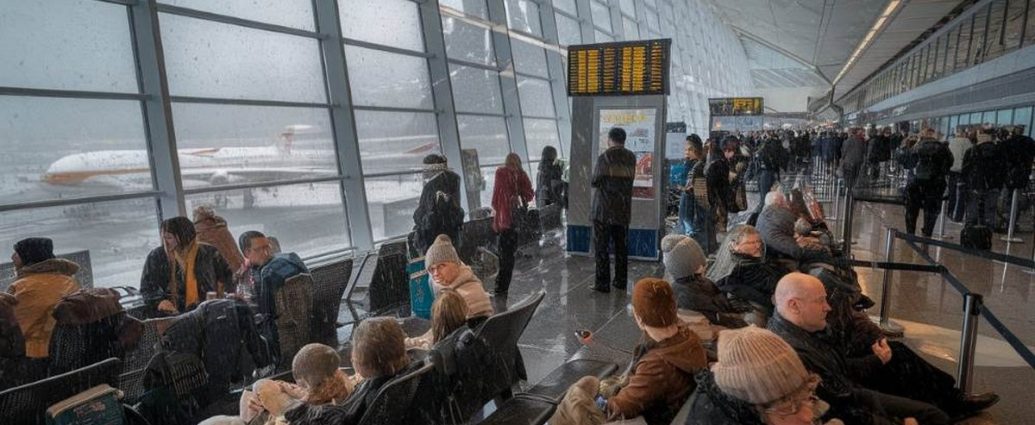
If you’re flying anywhere in Canada today, you’re probably not getting there on time. A massive winter storm system has crippled air travel coast to coast, with 105 flights cancelled and 428 delayed as of this afternoon.
The numbers tell the story. That’s 533 disrupted flights in a single day, affecting every major airport from St. John’s to Vancouver. The economic impact is staggering, with each cancelled flight costing airlines an estimated $8,000 to $15,000 in direct operational losses, not including passenger compensation and rebooking expenses.
- Total cancellations: 105
- Total delays: 428
- Airports affected: 9 major hubs plus regional airports
- Airlines impacted: Air Canada, WestJet, Jazz, United, others
Here’s what’s happening out there. Snow squalls are hammering Northwestern Ontario with wind gusts hitting 70-80 km/h.
Visibility is down to near zero in some spots. Heavy snow systems are pounding Nova Scotia and Newfoundland. Freezing rain warnings are active across multiple provinces.
Toronto Pearson alone has recorded 47 cancellations and 89 delays since 6 AM this morning (which, honestly, nobody saw coming). That represents roughly 12% of the airport’s daily flight operations, which typically handles about 1,200 flights per day during peak winter travel periods.
The Airports Getting Hit Hardest
Toronto Pearson is a mess right now (shocking, I know). So is Montreal-Trudeau. Calgary, Vancouver, Ottawa, Halifax, St. John’s, Saskatoon, and Regina are all reporting significant delays and cancellations.
Montreal-Trudeau International has suspended runway operations twice today, first from 11:30 AM to 1:15 PM, then again from 3:20 PM to 4:45 PM. The airport’s four snow removal teams are working in rotating shifts, but accumulation rates of 3-5 centimetres per hour are overwhelming their capacity.
Calgary International Airport reports that 23 flights have been cancelled and 67 delayed. The airport’s de-icing facility, which can handle up to 12 aircraft simultaneously, has a backlog stretching over two hours. Aircraft are being de-iced up to three times before takeoff due to continued snowfall.
But it’s not just the big airports. Smaller hubs like Prince George, Deer Lake Regional, Grande Prairie, and Kuujjuarapik are also dealing with grounded flights and frustrated passengers.
The worst part? This isn’t just affecting domestic travel. International routes are getting hammered too, with passengers stuck in terminals watching departure boards flip from “On Time” to “Delayed” to “Cancelled.”
Air Canada and WestJet are reporting the highest number of disruptions. Jazz Aviation, United, and several other carriers are also dealing with significant operational challenges.
“We’ve had to cancel 38 flights today, which affects approximately 6,800 passengers across our network,” said Sarah McKenzie, Air Canada’s Director of Operations Control. “Our teams are working around the clock to minimize disruptions, but passenger safety remains our absolute priority in these conditions.”
What Environment Canada Is Saying
The weather service has issued snowfall warnings, heavy snow advisories, and freezing rain alerts across Atlantic Canada, Ontario, and parts of the Prairies. That covers basically every region with major airport operations.
Northwestern Ontario is getting hit particularly hard with snow squalls and blowing snow. When you’ve got wind gusts of 70-80 km/h, runway operations become impossible. Visibility drops to nothing, and that means planes aren’t moving.
Meteorologist David Chen from Environment Canada’s Storm Prediction Centre explained the scope of today’s weather system. The low-pressure system stretches from Thunder Bay to Halifax, covering approximately 2,400 kilometres. Wind speeds have peaked at 87 km/h in Sudbury and 82 km/h in Moncton.
Halifax and St. John’s are dealing with heavy snow systems that require constant runway clearing.
The moment crews finish plowing, another few centimetres have already accumulated. Halifax Stanfield has received 28 centimetres of snow since midnight, with another 15-20 centimetres expected before the system moves offshore around 11 PM tonight.
February 2026 has been brutal for travel. We’ve seen a pattern of intense winter systems rolling through Canada all month. Freezing rain, heavy snow, dense fog, wind advisories. It’s been one weather system after another.
The current system represents the fourth major weather event this month to cause widespread flight disruptions. Previous storms on February 8th, February 15th, and February 22nd resulted in a combined 847 flight cancellations across Canadian airports.
The Operational Nightmare
Running an airport in these conditions is like trying to solve a puzzle while someone keeps changing the pieces. Snow removal crews are working around the clock, but they can only do so much when it’s coming down faster than they can clear it.
Toronto Pearson operates 65 pieces of snow removal equipment during major storm events, including 12 high-speed runway plows, 18 runway sweepers, and 35 various support vehicles. The airport’s snow removal budget for the 2025-2026 winter season is $47 million, and they’re already 78% through that allocation with a month of winter remaining.
De-icing operations become a major bottleneck. Aircraft need to be de-iced before takeoff, but in heavy snow, they need to be re-iced if there are delays. The whole process slows everything down.
At Vancouver International Airport, the four de-icing pads are operating at maximum capacity. Each de-icing operation takes between 12-45 minutes depending on aircraft size and contamination level. With current weather conditions, the facility can process approximately 20 aircraft per hour, but demand is running at 35 aircraft per hour.
Runway visibility is another huge factor. Pilots need to see where they’re going, and when you’ve got blowing snow reducing visibility to near zero, flights get grounded. Period.
Transport Canada requires minimum visibility of 550 metres for takeoff and 150 metres for landing under Category I instrument landing conditions. Current visibility at several airports is well below these minimums. Saskatoon reported visibility of just 100 metres at 2:30 PM, while Regina recorded 75 metres visibility during peak snowfall around noon.
Good luck with that.
Ground crews are dealing with hazardous conditions. Loading baggage and servicing aircraft becomes dangerous work when you’re dealing with ice-covered tarmacs and high winds.
“Our ground crew teams are following enhanced safety protocols today,” explained Mike Rousseau, Operations Manager at WestJet. “We’ve implemented 30-minute rotation schedules to prevent cold weather injuries, and all outdoor operations require two-person teams for safety. It slows us down, but we can’t compromise on worker safety.”
The Financial Impact on Airlines
Today’s disruptions represent a significant financial hit for Canadian airlines. Industry analysts estimate that weather-related flight cancellations cost the Canadian aviation sector approximately $125 million per year in direct operational losses and passenger compensation.
Air Canada, which operates roughly 1,500 daily flights during winter months, faces an estimated $680,000 in direct costs from today’s cancellations alone. This includes crew overtime, passenger rebooking, meal vouchers, hotel accommodations, and aircraft repositioning costs.
WestJet’s regional operations are particularly vulnerable to weather disruptions due to their extensive network of smaller airports across the Prairies and Atlantic Canada. The airline has cancelled 27 flights today, representing approximately 8% of their daily winter schedule.
Passenger compensation requirements under Canada’s Air Passenger Protection Regulations add another layer of expense. While weather delays are considered “extraordinary circumstances” and don’t trigger automatic compensation, airlines are still required to provide meals, accommodation, and rebooking at no extra charge.
Jazz Aviation, which operates regional routes for Air Canada Express, has been forced to cancel 18 flights today. Regional airlines face higher per-flight costs during weather events because they can’t easily substitute larger aircraft or consolidate passengers onto fewer flights.
What This Means for Passengers
If you’re stuck at an airport right now, you’re not alone. Thousands of passengers are dealing with the same situation across the country.
Approximately 58,000 passengers have been affected by today’s flight disruptions, based on average load factors and typical aircraft sizes. That’s nearly 60,000 people whose travel plans have been thrown into chaos by the weather system.
Check your flight status obsessively. Airlines are updating information as conditions change, but sometimes that means a flight that was delayed becomes cancelled, or vice versa.
Stay in contact with your airline. Most carriers are waiving change fees for weather-related disruptions, but you need to know your options. Some airlines are offering rebooking on the next available flight at no extra cost.
Keep your receipts. If you’re stuck overnight due to weather-related cancellations, some airlines will cover reasonable expenses for meals and accommodation. Check your airline’s policy.
Have a backup plan. If you absolutely need to get somewhere, consider alternative transportation. But honestly, if the planes can’t fly, driving probably isn’t much better.
Hotels near major airports are reporting high occupancy rates tonight.
The Fairmont Vancouver Airport Hotel is at 94% capacity, with most bookings coming from stranded passengers. Similar situations are reported at airport hotels in Toronto, Montreal, and Calgary.
For passengers dealing with today’s disruptions, the key is staying flexible and patient. Weather delays are frustrating, but they’re also unavoidable when safety is the priority.
The Ripple Effect
Here’s the thing about massive flight disruptions. They don’t just affect today’s travel. When hundreds of flights get cancelled or delayed, it creates a domino effect that can last for days.
Aircraft end up in the wrong cities. Flight crews hit their maximum duty hours and need rest. Passengers miss connections. Baggage gets separated from passengers.
Airlines are already working on recovery plans, but it takes time to get everything back on schedule. Some passengers might not reach their destinations until the weekend.
The cascading effects typically last 48-72 hours after the initial weather event. Air Canada expects full schedule normalization by Friday afternoon, while WestJet estimates their operations will return to normal by Saturday morning.
Business travellers are scrambling to reschedule meetings. Families are missing important events. Students are trying to get back to university after reading week.
Cargo operations are also severely impacted. Air Canada Cargo has suspended operations at three airports today, affecting time-sensitive shipments including medical supplies and perishable goods. The delay affects approximately 340 tonnes of cargo across the network.
Economic Impact Beyond Aviation
The broader economic impact extends far beyond airline operations. Business meetings worth millions of dollars in potential deals have been postponed or moved to video conferences. Tourism operators in affected destinations are dealing with no-show reservations and last-minute cancellations.
The Toronto Board of Trade estimates that weather-related travel disruptions cost the Greater Toronto Area economy approximately $23 million per day in lost productivity, missed meetings, and delayed business activities.
Supply chain disruptions are beginning to emerge as cargo flights face the same weather-related delays. Just-in-time manufacturing operations in Ontario and Quebec may experience parts shortages by Thursday if cargo operations don’t resume normal schedules by tomorrow morning.
Looking Ahead
The good news?
Weather conditions are expected to improve over the next couple of days. Environment Canada forecasts the storm system will move offshore by late tonight, with clearing skies expected across most of the country by Thursday morning.
Airlines are adding extra flights where possible to accommodate stranded passengers. Air Canada plans to operate 47 additional flights over the next three days to clear the passenger backlog.
WestJet is deploying larger aircraft on key routes to increase capacity.
If you’re planning to fly in the next few days, give yourself extra time. Check in early, arrive at the airport with plenty of buffer time, and have contingency plans ready.
Pack essentials in your carry-on. With the baggage system backlogged, checked bags might take longer than usual to catch up with passengers.
Airport authorities expect passenger volumes to remain 15-20% above normal through the weekend as travellers rebook their cancelled flights. Toronto Pearson is staffing additional customer service representatives and keeping all terminal restaurants open extended hours to accommodate the increased passenger load.
The long-term forecast shows another potential weather system developing early next week, though it’s too early to determine if it will impact aviation operations. February 2026 is on track to become one of the most disruptive winter months for Canadian air travel in the past five years.
Because apparently winter isn’t done with us yet, even though we’re heading into March. Welcome to flying in Canada during storm season.
Frequently Asked Questions
How many flights were cancelled in Canada today?
105 flights were cancelled and 428 were delayed across Canadian airports due to severe winter weather conditions.
Which airports are most affected by the storm?
Toronto Pearson, Montreal-Trudeau, Calgary, Vancouver, Ottawa, Halifax, St. John’s, Saskatoon, and Regina are all reporting significant disruptions.
What should passengers do if their flight is cancelled?
Contact your airline immediately, check for rebooking options, keep receipts for expenses, and consider alternative travel plans if urgent.