
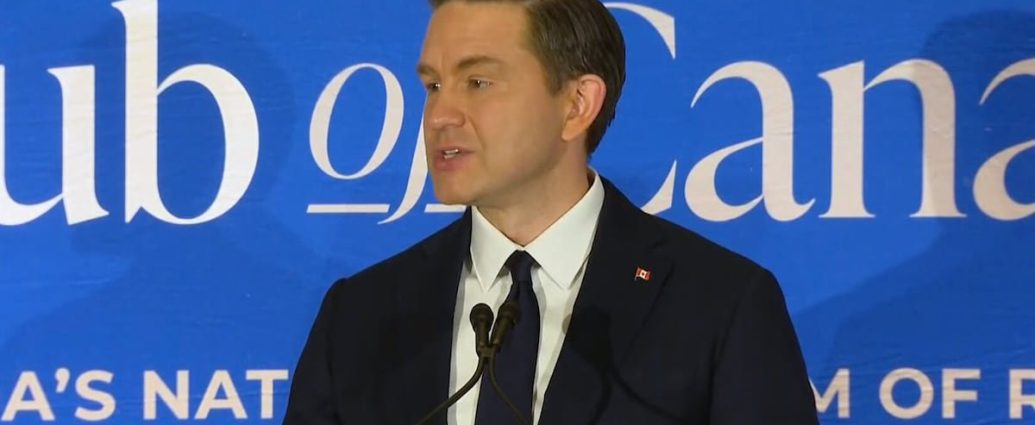
So what’s the deal when Canada’s Opposition leader tries to pitch a fresh approach for handling Donald Trump? Pierre Poilievre just showed us his answer, and it’s basically about getting stuff done instead of getting caught up in diplomatic theatrics.
Tuesday at the Canadian Chamber of Commerce, Poilievre spelled out how he thinks we should handle the U.S.-Canada relationship once Trump’s back in the White House. His take? Work together where you can, don’t kid yourself that China’s gonna save the day, and for crying out loud, don’t write off the country that buys most of our stuff.
Timing here matters. Big time. Trump’s promising a 10% tariff on everything coming into America, plus he wants another crack at the USMCA when it comes up for review in 2026. We’re looking at potential economic trouble that could cost Canada billions in lost trade money.
China Isn’t Your Safety Net
Poilievre didn’t dance around the China question. He made it pretty clear – China can’t replace the United States when we’re talking trade. That’s actually a pretty bold thing to say considering how much political energy’s been spent over the years trying to spread our trading bets around.
Look at the numbers though. He’s got a point.
The U.S. Buys roughly 75% of what we export – that’s $594.8 billion worth of Canadian stuff in 2023. China? They’re sitting at 4.3% of our exports, about $25.4 billion last year. You can’t just swap that kind of relationship out, even with a market as huge as China’s.
“China is no substitute for the United States,” Poilievre told the business crowd, basically cutting through years of wishful thinking. “We need to be realistic about where our economic future lies and stop pretending we can simply pivot away from our most important trading relationship.”
This isn’t just dollars and cents either. The whole geopolitical game has changed since everyone thought doing more business with China was a no-brainer. Remember COVID? That really opened people’s eyes to how fragile these global supply chains can be. Then you’ve got all the tech transfer worries as both America and Canada try to protect their sensitive stuff.
Don’t forget what happened with Huawei executive Meng Wanzhou getting arrested in Vancouver back in 2018.
China grabbed Michael Kovrig and Michael Spavor and held them for almost three years. That whole mess showed how fast your trade relationship with China can turn into a hostage situation when bigger political stuff gets in the way. Lot of Canadian businesses are still pretty nervous about putting too many eggs in the Chinese basket, especially in important sectors.
Playing Nice With Trudeau’s Team
Here’s where it gets interesting politically. Poilievre said he’d “work together where we can” with Justin Trudeau’s Liberal government on trade headaches. That’s worth noting because it sounds like he’s willing to put the partisan stuff aside when it’s about defending Canadian interests against potential U.S.
Trade hits.
This cooperation offer comes while the government’s under pressure to figure out how to respond to Trump’s trade policies. The president-elect has already hinted he wants to take another look at the USMCA and made some pretty specific threats about tariffs on Canadian energy exports – oil, electricity, the works.
Business folks have been pushing for exactly this kind of bipartisan approach. When you’re dealing with a trading partner that buys three-quarters of your exports, you need everyone pulling in the same direction, not politicians scoring points.
The Canadian Chamber of Commerce has been calling for what they call a “Team Canada” approach, like what happened during the original NAFTA renegotiation from 2017 to 2020.
During those earlier talks, Trudeau’s government worked with provincial premiers, business leaders, even opposition politicians to show a united front. That teamwork helped get the USMCA deal done, though we had to give up some things in dairy market access and how disputes get settled.
Don’t Burn Bridges
Poilievre also warned against declaring a “permanent rupture” with the United States. Might sound obvious, but it’s actually pretty important given how hot things can get during trade fights and how some folks in Canadian politics have suggested more confrontational approaches.
We’ve been through serious trade tensions before. The softwood lumber fights have been going on and off since the 1980s, costing Canadian producers billions in tariffs and legal bills.
The 2018-2020 NAFTA renegotiation period was pretty rough, with Trump threatening to pull out of the whole agreement and slapping steel and aluminum tariffs that cost Canadian producers about $3.2 billion a year.
Make of that what you will.
Every time these disputes blow up, you hear voices saying Canada should diversify away from the U.S. Market or get tougher in negotiations. But here’s the thing – geography matters. A lot.
We share the world’s longest undefended border with the Americans (8,891 kilometers), our supply chains are tangled up together across tons of sectors, and about 7.5 million Canadian jobs depend directly or indirectly on trade with the United States.
That doesn’t mean Canada should roll over in negotiations. It means being smart about when to push back and when to find common ground. The 2019 steel and aluminum tariff mess got sorted out after Canada threatened to hit back on $3.6 billion worth of U.S.
Imports – showed that measured responses can actually work.
What Business Leaders Want to Hear
Wasn’t an accident that Poilievre gave this speech to business leaders.
The business community’s been pretty vocal about wanting political stability and predictability in how Canada deals with the U.S. Especially with all this potential economic disruption looming.
Companies operating across the border need to make investment decisions worth billions. When the political relationship gets rocky, it creates uncertainty that can delay projects, mess up supply chain planning, and generally make life difficult for anyone trying to run a cross-border business.
Auto sector’s the perfect example of how integrated we’re. Canadian and American car plants are so connected that parts can cross the border multiple times during manufacturing. The automotive industry supports about 500,000 Canadian jobs and adds $19.4 billion annually to Canada’s GDP. Any hiccup in cross-border flows hits the economy immediately.
During the worst of the USMCA renegotiations, several major auto investments got put on hold. Ford delayed a $1.2 billion plant expansion in Ontario. General Motors postponed decisions on future vehicle production until the trade uncertainty got cleared up.
“We can’t have our trade policy held hostage to political theater,” said Goldy Hyder, President and CEO of the Business Council of Canada, after Poilievre’s speech. “The Conservative leader’s commitment to pragmatic cooperation gives us hope that Canada can present a united front regardless of which party is in power.”
Energy in Trump’s Crosshairs
One of the most immediate headaches facing Canadian policymakers is Trump’s renewed focus on energy trade. Canada ships about 4.3 million barrels of oil per day to the United States – that’s roughly $124 billion annually and represents about 97% of all Canadian oil exports.
Trump’s made conflicting statements about Canadian energy. Sometimes he praises how reliable Canadian supply is, other times he threatens tariffs on energy imports as part of broader trade negotiations. The energy sector employs over 280,000 Canadians directly and supports hundreds of thousands more jobs indirectly, particularly in Alberta, Saskatchewan, and Newfoundland and Labrador.
Poilievre’s approach emphasizes the mutual benefits of energy trade. Canadian oil helps reduce American dependence on less stable suppliers, and integrated North American energy markets make the whole continent more energy secure.
This framing tries to position Canada as an ally rather than a competitor in Trump’s “America First” energy strategy.
The electricity trade relationship is equally important but often gets overlooked. Canada exports about 11% of its electricity production to the United States – worth about $4.6 billion annually. States like New York, Maine, and Minnesota depend heavily on Canadian hydroelectric power, especially during peak demand periods.
Real Impact on Canadian Families
Behind all the political positioning and trade statistics are real impacts on Canadian families and communities. The U.S.-Canada trading relationship supports jobs in basically every sector of the Canadian economy – from resource extraction to advanced manufacturing to services.
In Ontario alone, about 1.7 million jobs are linked to trade with the United States. In Alberta, that figure’s around 400,000 jobs, many in the energy sector. Even in smaller provinces, the ripple effects of U.S.
Trade create job opportunities that might not otherwise exist.
For Canadian consumers, trade disruptions usually mean higher prices for everything from food to electronics to vehicles. During the 2018-2019 tariff disputes, Canadian families saw increases in the cost of steel-heavy products, including appliances and construction materials.
The service sector relationship is equally important but gets less attention. Canadian engineering firms, financial services companies, and tech businesses depend heavily on U.S. Market access. Professional services exports to the United States were worth $37.2 billion in 2023, supporting high-paying jobs across the country.
Premiers Are Watching
Poilievre’s pragmatic approach has drawn cautious support from provincial premiers across party lines. They understand that trade disputes with the United States can wreck regional economies regardless of federal political calculations.
Alberta Premier Danielle Smith has been particularly vocal about needing federal-provincial coordination on energy trade issues. Saskatchewan Premier Scott Moe has similar concerns about agricultural exports, especially since the U.S. Market absorbs about 52% of Canadian agricultural exports – worth $27.8 billion annually.
Even premiers from traditionally more protectionist provinces get what’s at stake. Quebec Premier François Legault has noted that despite efforts to diversify, the United States still accounts for 72% of Quebec’s international exports, worth approximately $65 billion annually.
Where We Go From Here
Poilievre’s approach signals a more pragmatic Conservative stance on U.S. Relations than we’ve sometimes seen before. Instead of ideological positioning, he’s focusing on practical outcomes and measurable results for Canadian businesses and workers.
This matters because it suggests that if there’s a change of government federally, Canada’s approach to the U.S. Wouldn’t undergo some dramatic shift. That kind of continuity is exactly what the business community wants to hear, particularly as companies make investment decisions that’ll play out over multiple electoral cycles.
It also puts pressure on the current government to match that pragmatic tone. If the Opposition is offering cooperation on trade issues, it becomes harder to justify a more confrontational approach that might backfire economically and cost Canadian jobs.
The challenge, of course, is that being reasonable only works if both sides are willing to play that game. Trump’s approach to trade negotiations hasn’t always been known for moderation or predictability. His threat to impose universal tariffs could affect $429 billion worth of Canadian exports, potentially triggering a recession here if implemented broadly.
The key insight is that Canada needs to be prepared for multiple scenarios while maintaining the relationship that supports millions of Canadian jobs and hundreds of billions in economic activity. That means having backup plans for various trade disputes, keeping relationships with key American players beyond just the federal government, and being ready to defend Canadian interests when necessary while keeping the bigger picture in focus.
For Canadian policymakers, workers, and businesses, this approach offers at least some reassurance that political leaders understand what’s economically at stake. The U.S.
What This Means Going Forward
Market isn’t going anywhere, and neither is Canada’s dependence on that trading relationship. The challenge is making it work in a more complex and sometimes hostile political environment while protecting the prosperity that millions of Canadian families depend on.
Frequently Asked Questions
What did Poilievre say about China as a trading partner?
Poilievre stated that China is no substitute for the United States as Canada’s primary trading partner.
Will Poilievre work with the current government on trade issues?
Yes, Poilievre pledged to ‘work together where we can’ with the Carney government on trade challenges.
What is Poilievre’s stance on U.S.-Canada relations?
Poilievre warned against declaring a ‘permanent rupture’ with the U.S. and advocated for pragmatic cooperation where possible.