
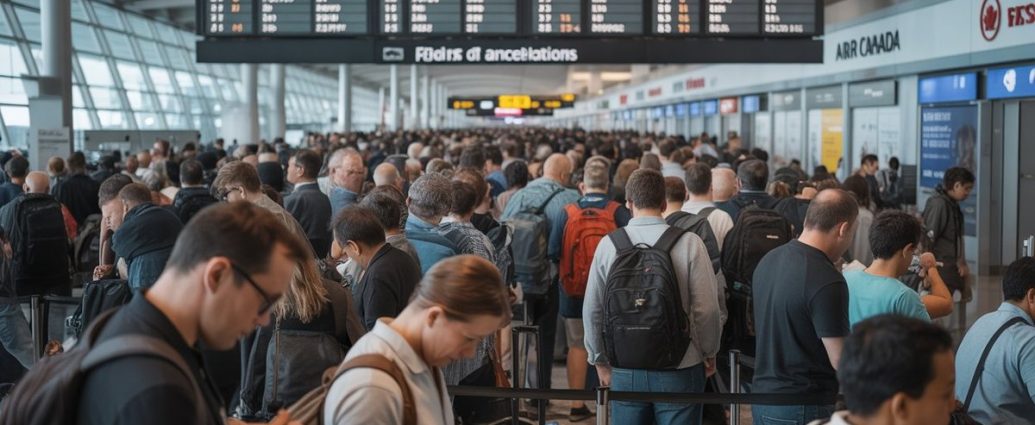
Winter storms hammered Toronto Pearson International Airport today, leaving hundreds of passengers stranded as 233 flights got delayed and 21 cancelled across multiple airlines. The chaos spread throughout Canada’s busiest airport, creating a ripple effect that hit routes to Vancouver, Montreal, Ottawa, and international destinations.
- 233 flights delayed
- 21 flights cancelled
- Multiple airlines affected: Air Canada, Jazz, Porter Airlines
- Routes disrupted: Vancouver, Montreal, Ottawa, New York, London
- Pearson typically handles 50+ million passengers annually
Perfect Storm of Weather and Logistics
The disruption wasn’t just about snow. A combination of severe weather conditions, poor visibility, and logistical nightmares created the perfect storm at YYZ today.
Winter storms across North American airspace triggered air traffic delays that cascaded through the system. But here’s where it gets messy: staffing shortages, increased passenger volume, and aircraft rotation problems turned what should’ve been manageable weather delays into a full-blown operational crisis.
The Greater Toronto Airports Authority (GTAA) found their coordination systems stretched thin. Air traffic control, baggage handling, and ground operations all hit bottlenecks at the same time when adverse weather mixed with peak passenger traffic.
Looking at the breakdown by airport, the data tells the story: Toronto Pearson saw 120 delayed flights (24% of operations) and 10 cancellations (2%). But the ripple effects hit everywhere from Ottawa Macdonald-Cartier (3 delays, 2 cancellations) to Vancouver International (5 delays, 1 cancellation).
The weather system brought visibility down to less than a quarter mile at times. This forced air traffic controllers to increase spacing between aircraft and reduce landing rates. What normally would be a steady stream of arrivals and departures every 60-90 seconds stretched to three or four-minute intervals.
Ground crews battled freezing temperatures and snow accumulation that required constant de-icing operations. Each de-icing procedure added 15-30 minutes to departure times, while aircraft had to return to gates when delays exceeded maximum allowable de-icing windows.
Airlines Scrambling to Manage Chaos
Air Canada took the biggest hit with 111 delayed flights (36% of their operations) and 16 cancellations (5%). Jazz, their regional partner, saw 14 delays (13%) and 4 cancellations (3%). Porter Airlines had 23 delays (25%) and 1 cancellation (1%).
The numbers don’t tell the human story though. Passengers faced overwhelmed customer service infrastructure as airlines like Air Canada, WestJet, and American Airlines worked frantically to rebook everyone onto the next available flights.
Problem is, when you’ve got this many delays hitting at once, there aren’t enough seats on later flights. Long lines formed at check-in counters and service desks while customer service phone lines stayed jammed for hours.
International passengers heading to long-haul destinations got hit hardest. Routes to New York, London, Vancouver, and Montreal saw major disruptions, leaving travellers uncertain about their next moves. Honestly, it was chaos.
WestJet said they were able to accommodate 78% of affected passengers on same-day flights, but that still left hundreds scrambling for alternatives. American Airlines saw their Dallas-Fort Worth connection experience 20% delays, while their Miami route hit 40% delays as crew scheduling complications mounted.
Air Canada’s hub-and-spoke system meant connecting passengers from smaller Canadian cities faced double impacts. A delayed flight from Thunder Bay didn’t just affect those passengers – it meant missed connections to international destinations, creating a domino effect that reached across continents.
The airline deployed extra customer service staff from their Montreal and Vancouver bases. But even with reinforcements, wait times for assistance averaged 45 minutes to two hours throughout the day.
Passengers Share Their Frustration
The human cost of these operational failures became clear as passengers shared their experiences waiting in an overwhelmed airport system.
“We were supposed to leave at 7 AM for London, and it’s now 3 PM. I’ve been rescheduled three times, and they can’t even tell me if tonight’s 9 PM departure will actually happen. My hotel booking expires tomorrow and I’m looking at hundreds in extra costs.”
That’s Julia Martin, a business consultant from Toronto, after waiting nearly eight hours just to get concrete information about her British Airways connection. Her experience echoed throughout the terminals today.
Business traveller John Davis faced his own crisis trying to reach a meeting in Vancouver that was worth $50,000 in potential contracts:
“I’ve missed three rescheduled flights, and they’re telling me maybe tomorrow morning now. This isn’t just an inconvenience – it’s costing my company real money. We expect better from Pearson.”
For business travellers, the delays meant missed meetings and appointments. Families had to alter vacation plans or book last-minute hotel rooms near the airport at premium rates. Airport hotels were charging $300-400 per night as demand spiked.
Sarah Chen, travelling with two young children to visit family in Montreal, found herself paying $180 for meal vouchers and entertainment to keep her kids occupied during a seven-hour delay that stretched from morning to evening.
Some passengers made the best of it. They bonded with fellow stranded travellers or explored Pearson’s lounges and restaurants. But that doesn’t change the stress, confusion, and financial impact hitting thousands of people today.
International students heading back to universities after winter break faced particular hardship. Many carried tight budgets that couldn’t absorb unexpected hotel and meal costs. Several were seen sleeping on terminal benches as the day wore on.
Infrastructure Vulnerabilities Exposed
Here’s the thing that’s really concerning: Toronto Pearson has advanced infrastructure and typically runs with high efficiency. This disruption exposed some serious vulnerabilities in how the system handles peak-season stress combined with weather events.
The airport processes over 50 million passengers annually, so it’s built for volume. But when multiple systems fail at the same time, even the best infrastructure can get overwhelmed fast.
Weather-related disruptions revealed gaps in coordination between air traffic control, ground operations, and passenger services. During adverse weather, these systems need to work in perfect sync. Today proved they don’t always manage that.
The cascading effect is what makes these situations so brutal. One delayed flight means gate conflicts, crew scheduling issues, baggage backlogs, and passenger rebooking headaches. Multiply that by 233 delays and you get operational chaos.
Baggage handling became a particular nightmare as delayed flights meant thousands of checked bags piling up in processing areas. The automated baggage system, designed for steady flow, couldn’t adapt quickly enough to the stop-and-start pattern of weather delays.
Gate availability created another bottleneck. Pearson has 119 gates across its four terminals. But when flights that should’ve departed sit at gates for hours, incoming aircraft have nowhere to park. This forced some arriving flights to wait on taxiways for up to 90 minutes.
The GTAA’s crisis management protocols, designed for isolated incidents, struggled with the scale of simultaneous disruptions. Communication systems between different airport departments experienced delays of 15-20 minutes. This meant passengers often received outdated information.
Broader Impact Across Canadian Aviation
The disruptions didn’t stay contained to Pearson. Canadian aviation saw ripple effects from coast to coast as connecting flights, crew rotations, and aircraft positioning all got thrown off schedule.
Regional airports like Sudbury (14% delays), Thunder Bay (50% delays), and Sydney, Nova Scotia (25% delays) saw their own problems as aircraft and crews got stuck in the Toronto bottleneck. Even Montreal-Trudeau experienced 50% cancellations and 25% delays on Toronto routes.
This highlights how interconnected Canada’s aviation system really is. When the country’s biggest hub hits problems, the effects spread everywhere. Airlines operating point-to-point routes through Pearson suddenly find themselves with aircraft and crews in the wrong places.
International carriers also got caught up. The data shows flights from Dallas-Fort Worth (20% cancellations), Miami (10% cancellations, 40% delays), and Zurich (100% cancellations) all facing major disruptions as the North American airspace system struggled with weather-related slowdowns.
Porter Airlines operates primarily out of Toronto’s downtown Billy Bishop Airport. They saw spillover effects as passengers tried to switch between airports. Their connecting shuttle services experienced 300% higher demand than normal.
The economic impact extends beyond airlines. Airport retailers, restaurants, and service providers saw mixed results – some benefited from stranded passengers spending money, while others lost revenue from cancelled flights and reduced passenger flow.
Cargo operations also took hits. FedEx, UPS, and Canada Post experienced delays in parcel processing that’ll affect deliveries across Ontario and Quebec for the next 48-72 hours.
What This Means for Canadian Travellers
If you’re flying through Pearson in the coming days, expect lingering effects. Airlines will be working through rebooking backlogs, and aircraft positioning will take time to normalize. Industry experts predict residual delays could last 48-72 hours as the system rebalances.
The incident also raises questions about winter preparedness at Canadian airports. We get harsh weather every year, yet these disruptions keep happening when conditions get challenging. Transport Canada will likely review today’s events as part of ongoing airport performance evaluations.
For passengers, it’s a reminder that travel insurance and flexible booking options aren’t just nice-to-haves during winter months. They’re essential protection against exactly this kind of operational breakdown. Claims from today’s disruptions could reach $2-3 million across all affected travellers.
Airlines will face compensation claims under Canada’s Air Passenger Protection Regulations. Passengers on cancelled flights can claim up to $1,000 depending on circumstances, while those with delays over three hours may be entitled to $400-700 in compensation plus meal and accommodation costs.
The Canadian Transportation Agency will monitor how airlines handle these compensation claims. Previous weather-related disruptions have led to enforcement actions when airlines failed to meet their obligations to passengers.
Looking ahead, this incident highlights the need for better real-time communication systems between airports, airlines, and passengers. Mobile apps and text alerts showed significant delays in updating accurate information. This left people making decisions based on outdated data.
The aviation industry will need to examine whether current staffing levels and coordination protocols can handle the combination of peak travel periods and severe weather. Today’s chaos suggests they can’t always manage both at the same time.
What This Means Going Forward
And here’s what’s really troubling – climate change means more extreme weather events, so these kinds of disruptions may become more frequent. Airports and airlines need better contingency planning that accounts for the reality of Canada’s harsh winters combined with increasing passenger volumes and more complex aircraft scheduling systems.
Frequently Asked Questions
How many flights were delayed at Toronto Pearson today?
233 flights were delayed and 21 flights were cancelled at Toronto Pearson International Airport due to winter storms and operational challenges.
Which airlines were most affected by the delays?
Air Canada saw the biggest impact with 111 delayed flights and 16 cancellations, followed by Jazz with 14 delays and 4 cancellations, and Porter Airlines with 23 delays.
What caused the massive flight disruptions at Pearson?
A combination of severe winter weather, poor visibility, staffing shortages, increased passenger volume, and aircraft rotation problems created the operational crisis.