
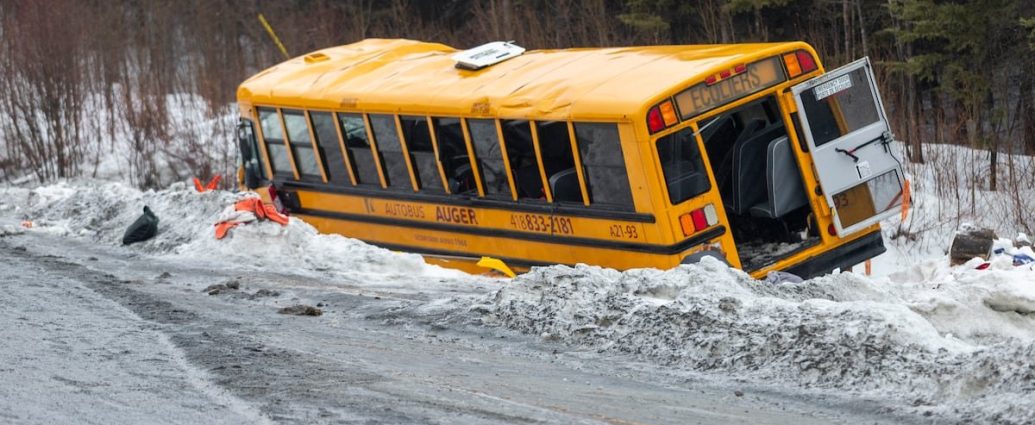
What do you do when the worst thing you can imagine happens on what’s supposed to be just another Tuesday morning?
That’s what one Quebec community is dealing with right now. A school bus crash in the Chaudière-Appalaches region this morning killed one child and hurt 17 others. The accident happened near the U.S.
Border around 7:45 AM, turning what started as a regular ride to school into every parent’s absolute worst fear.
How It All Went Wrong
The whole thing happened on Highway 173 in Saint-Georges, Quebec. About 90 kilometers south of Quebec City.
The yellow school bus was carrying 18 kids, ages 6 to 14, plus the driver and someone keeping an eye on things. Transport Scolaire du Richelieu runs the bus service.
Here’s what the Sûreté du Québec figured out so far: the bus went off the road around a curve and slammed into a concrete bridge support at about 60 kilometers per hour. Hit hard enough to crush the front third of the bus and blow out a bunch of windows on the side where kids sit.
Emergency crews got there at 7:52 AM. They found one 8-year-old in really bad shape and 19 others hurt in different ways. The kid in critical condition got helicoptered to CHU de Québec-Université Laval trauma center within 45 minutes. But it wasn’t enough. They died at 11:30 AM.
- Where: Highway 173, Saint-Georges, Chaudière-Appalaches region
- When: 7:45 AM local time
- Casualties: 1 child dead, 17 injured
- Vehicle: 2019 Thomas Built Buses school bus
- Speed at impact: Around 60 km/h
- Date: March 8, 2026
The bus driver’s name is Marcel Bouchard. He’s 52, been doing this for 18 years. Got hurt pretty bad but not life-threatening stuff. They took him to Hôpital de Saint-Georges. The monitor, Julie Tremblay (she’s 34), broke her arm and got a concussion. But she’s stable.
Roads were wet but not icy. Temperature was around 2°C. You could see fine – no fog or rain when it happened. The emergency response was massive. Within 15 minutes of someone calling 911, the place was crawling with 12 ambulances, 4 fire trucks, and police cars from everywhere.
When Everything Goes Sideways Fast
“When we got there, we knew right away this was going to be big,” said Capitaine Pierre Nadeau from Saint-Georges Fire Department. “Our guys immediately started figuring out who needed help most while we worked to get three kids unstuck from their seats.”
Of the 17 survivors who got hurt, 8 were in serious but stable condition. Six had moderate injuries. Three just had cuts and bruises.
The kids who were hurt worst got sent to specialized children’s hospitals. Five went to CHU Sainte-Justine in Montreal, three to CHU de Québec. The rest got treated locally at Hôpital de Saint-Georges and Centre de santé Beauce-Etchemin. Four kids went home the same day after doctors checked them over. Others are looking at longer stays.
Dr. Sylvie Bérubé runs emergency medicine at CHU de Québec. She told reporters:
“We kicked our mass casualty plan into gear the second we got the call. Our teams were ready and waiting when the helicopters showed up. We’re heartbroken about losing that young life, but I’m cautiously hopeful about how the other injured kids will recover.”
You could see how well they’ve got this stuff rehearsed (no, seriously). Hydro-Québec crews came to deal with power lines that got knocked down. Transport ministry engineers checked if the bridge was still safe.
Are School Buses Actually Safe?
This is happening when Canada’s got a pretty decent track record with school buses, actually. Transport Canada says school buses are in fewer than 50 serious crashes every year across the whole country.
Usually only 2-3 kids die annually.
Quebec’s got one of the tightest school bus systems in North America. They’ve got 3,200 school buses moving about 520,000 kids every day, covering more than 85 million kilometers each year.
Drivers have to do 35 hours of training up front, then 7 more hours every year to keep their certification.
That 2019 Thomas Built bus had all the standard safety stuff. Reinforced steel frame, seats designed to absorb impact, emergency roof hatches, electronic stability control. It passed its safety check on February 15 – just three weeks ago.
Transport Scolaire du Richelieu’s been around for 34 years and they’ve got a spotless safety record. They move 4,800 kids every day on 47 different routes in the Chaudière-Appalaches area. Never had a fatal accident before this.
Quebec makes buses get inspected every 4 months. Most other provinces do it every 6. Drivers get randomly tested for drugs and alcohol. Every bus has to have GPS and two-way radios.
But here’s the thing – you can’t make everything 100% safe.
Weather happens. Roads aren’t perfect. People make mistakes. It’s just reality. Sûreté du Québec’s got a full investigation going. Sergent-détective Marie-Claude Dubois is running it – she’s an expert at reconstructing vehicle accidents. They’re saying 8-12 weeks to get answers.
Figuring Out What Actually Happened
They’re already looking at the bus’s black box, which records speed, braking, steering – basically everything that happened in the 30 seconds before impact. Early data shows the bus was doing 70 km/h (the speed limit) before suddenly slowing to 60 km/h when it hit.
Transport ministry’s accident team got there at 2:30 PM to check road conditions, signs, whether the road design might’ve played a part. Highway 173’s had 23 accidents in the past five years, but none with school buses.
Environment Canada confirms road temperatures were just above freezing, no black ice (shocking, I know). But investigators want to know if overnight frost might’ve created slippery spots that melted as things warmed up.
They’re going to take that bus apart. Check the brakes, tires, steering, electronic systems. Maintenance records show routine service 1,200 kilometers before the crash. Nothing wrong noted.
Driver Marcel Bouchard got tested right away to rule out impairment. Early results show no alcohol or drugs. His driving record’s clean – no tickets in the past decade.
They’re also looking at whether he was tired. Bouchard had 10 hours off before starting his morning route at 6:30 AM. That meets provincial rules for commercial drivers.
What This Means for Families Right Now
The fallout’s already starting. Commission scolaire des Appalaches oversees 28 schools with 8,400 students. They shut down all bus service for the rest of the day while doing emergency safety checks.
Parents across the region suddenly had to figure out how to get their kids home. École Primaire Saint-Antoine, where most of the crash victims went to school, let kids out early and brought in grief counselors for the week.
Money-wise, this is going to be expensive. Similar accidents cost more than $2.5 million in medical bills. The province’s school insurance fund covers transportation injuries up to $5 million per incident.
For those 17 injured kids, recovery’s going to take different amounts of time. The 8 with serious injuries might need months of rehab. That affects school, family finances, everything. Quebec’s healthcare system covers the medical stuff, but families often end up paying for other things like lost wages and special equipment.
The mental impact goes way beyond just the victims. Transport Canada research shows school bus accidents directly affect 150-200 people – family, classmates, teachers, first responders. PTSD symptoms can stick around for years, especially with kids who saw it happen.
Quebec school boards are looking at their crisis communication plans after today. Lots of districts don’t have specific procedures for telling parents about transportation accidents. News spreads on social media before official word gets out, which creates panic.
This’ll probably restart arguments about seatbelts on school buses. Quebec doesn’t require them on buses over 4,500 kilograms.
They follow federal guidelines that say the protective seating design is enough protection. But some safety people think restraints might’ve prevented some of today’s injuries.
What Changes Now
This crash is probably going to change school transportation policy across Canada. Previous fatal school bus accidents led to big regulatory changes.
Like mandatory electronic stability control after a 2008 rollover in BC killed 4 students.
Quebec government’s already announced they’re fast-tracking a review of school bus safety standards. Ninety days to finish it.
Education Minister François Legault said they’ll implement every recommendation from the accident investigation, no matter what it costs.
Insurance people think school transportation premiums could go up 15-20% across Quebec as companies reassess risks. School boards are already tight on money, so this could mean less service or combined routes.
Technology improvements might speed up because of what happened today. Advanced driver assistance – collision avoidance radar, lane departure warnings – that stuff’s becoming standard on commercial vehicles. But school buses haven’t adopted it much because it costs too much.
The investigation findings will get shared with transportation authorities across North America. Similar roads and conditions exist in thousands of places, so any hazards they identify matter way beyond Quebec.
For the family that lost their child today, none of the policy talk matters much. They’ve unwillingly become advocates for better school bus safety, joining a small group of families who’ve been through similar losses.
The investigation will give technical answers about what went wrong on Highway 173 this morning. What it can’t do is give back the sense of safety this community had when they put their kids on the bus, assuming – like thousands of times before – that they’d make it to school just fine.
Frequently Asked Questions
Where did the Quebec school bus crash occur?
The crash happened in Quebec’s Chaudière-Appalaches region, near the U.S. border, south of Quebec City.
How many people were injured in the school bus accident?
One child died and 17 others were injured when approximately 20 people were aboard the school bus during the crash.
What caused the school bus crash in Quebec?
The exact cause of the crash remains under investigation by police, with no official details released about the circumstances yet.