
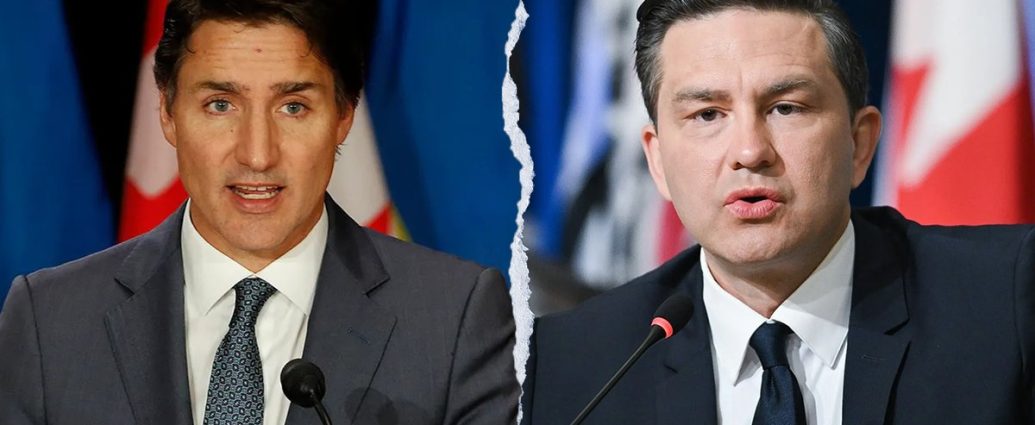
Pierre Poilievre thinks calling an election right now would be completely nuts.
The Conservative leader says Canada’s got to focus on that CUSMA trade deal review before anyone starts thinking about hitting the campaign trail. With Trump heading back to the White House and already making noise about tariffs, Poilievre figures this isn’t exactly prime time for political games.
Look, timing’s everything here. CUSMA’s up for review in 2026, and there’s already chatter about changing the rules. Tossing an election into that mess? Not exactly what you’d call smart planning.
The stakes are huge.
Canada-U.S. Trade hit $904 billion last year, making the Americans our biggest trading partner by a mile. That’s about 75% of everything we sell abroad, keeping roughly 3.5 million Canadians employed. When you’re talking numbers like that, screwing up trade policy isn’t just bad economics. It’s a disaster waiting to happen.
What Poilievre’s really getting at
Here’s what’s interesting about Poilievre’s take. He’s calling Trump’s recent shots at Canada ‘wrong’ while still pushing for stable trade relations with the U.S. Pretty careful balancing act there. He’s not kissing Trump’s ring, but he’s also making it crystal clear that keeping our biggest economic partnership intact has to come first.
“Canada shouldn’t have an election before we get through this trade review process,” Poilievre told reporters at a press conference in Ottawa last week. “We need everyone focused on protecting Canadian jobs and making sure our economy doesn’t become a political football.”
The Conservative leader’s trying to position himself as the guy who can keep things steady during trade talks. Whether you’re buying what he’s selling probably depends on what you think about his foreign policy chops.
Thing is, Poilievre’s argument goes deeper than just timing. His people point out that the feds would need their best trade negotiators, economic advisors, and diplomatic staff all working overtime for any serious CUSMA review. Running election campaigns at the same time? That’s splitting your attention right when you can’t afford to.
The Conservative leader’s been pretty harsh about how he sees the current government handling U.S. Relations. He thinks Justin Trudeau’s crew has been too busy with feel-good messaging and not focused enough on protecting Canadian economic interests.
The calendar’s working against us
Worth looking at the timeline here. CUSMA’s got this review thing built right in – kicks in six years after it started on July 1, 2020.
That puts the mandatory review smack in the middle of 2026.
And here’s the kicker: Trump’s people are already floating changes to North American trade rules. So we might end up negotiating while running campaign ads. Not exactly ideal.
This review process isn’t automatically a full renegotiation, mind you. It’s supposed to be more like a health check where all three countries – Canada, the U.S. And Mexico – take a look at how things are working. But with the political climate down south? Nobody’s expecting them to just rubber-stamp everything.
Robert Lighthizer, who was Trump’s trade guy the first time around, has already dropped hints that the new administration wants to revisit several key parts. We’re talking dairy market access, Buy American rules, and those dispute resolution mechanisms that Canada fought tooth and nail to keep during the original NAFTA mess.
The numbers tell you why this matters so much. Canadian farm exports to the U.S. Were worth $28.9 billion in 2023. Manufacturing exports hit $198 billion. Energy exports reached $156 billion. Every single one of these sectors could get hammered if CUSMA talks go sideways.
Honestly? This could turn into a real nightmare if our government’s busy campaigning instead of doing trade deals. History shows that trying to juggle both usually doesn’t work out great for Canada.
Trump changes the whole game
Let’s be honest about what we’re dealing with here. Trump’s back, and he’s already making noise about trade deals that don’t help American workers enough.
Renegotiating NAFTA was one of his biggest wins last time. He’s not going to go easy on CUSMA, especially if he thinks he can squeeze better terms out of Canada and Mexico.
The math’s pretty stark. The U.S. Had a $63 billion trade deficit with us in 2023 – something Trump’s complained about plenty. His team’s already talking about maybe hitting Canadian goods with 25% tariffs if they don’t get what they want in any new deal.
“We can’t let ourselves get caught flat-footed like we did during the first NAFTA renegotiation,” said former Conservative trade minister Ed Fast, who’s been helping out Poilievre’s team. “Trump plays hardball, and Canada needs a solid game plan from the start.”
Poilievre gets this dynamic. His comments about wanting U.S. Trade stability aren’t just diplomatic politeness. They’re him recognizing that Canada better be ready for whatever Trump decides to throw at the negotiating table.
The Conservative leader’s been studying Trump’s first-term playbook pretty carefully. Between 2017 and 2020, Trump threatened to pull out of NAFTA completely at least six times, used steel and aluminum tariffs to push us around, and kept saying Canada was taking advantage of American generosity.
This time, Trump’s team knows what they’re doing. They’ve got experience and they know exactly which buttons to push. Canada’s problem is that some of the stuff we gave up during the original CUSMA talks – particularly around dairy and cultural protections – aren’t seen as enough by some U.S. Negotiators now.
What This Means Going Forward
Question is whether Poilievre would actually handle those talks better than what we’ve got now. That’s debatable, obviously. But his positioning suggests he thinks trade policy should beat electoral politics right now.
Real impact on working Canadians
The actual fallout from any trade mess won’t hit Ottawa boardrooms or political backrooms (which, honestly, nobody saw coming). It’ll slam Canadian workers and families directly.
Take Ontario’s manufacturing, which employs about 764,000 people and depends big-time on supply chains connected to U.S. Companies. A 25% tariff on our stuff would make tons of these operations completely uncompetitive overnight. The Automotive Parts Manufacturers’ Association figures major trade disruptions could wipe out up to 125,000 jobs in Ontario alone.
Different story out west, but just as serious. Alberta’s energy sector, supporting around 280,000 direct and indirect jobs, needs U.S. Refineries to process most of its crude oil. Any restrictions on energy trade could devastate communities from Fort McMurray down to Calgary.
Forestry’s another perfect example of how vulnerable we’re. BC’s forest industry employs roughly 100,000 people directly, with exports to the U.S. Worth about $12 billion annually. Lumber tariffs during Trump’s first go-around already cost the industry thousands of jobs. A bigger trade war could finish off communities that are already struggling with mill closures and resource problems.
Poilievre’s people have been crunching these numbers.
Not ideal.
They figure even a six-month disruption in trade relations could cost Canada’s economy over $45 billion and eliminate more than 200,000 jobs. Those aren’t just statistics – they’re real families facing real trouble.
The Conservative leader’s been particularly focused on what he calls “economic security” for Canadian families. His pitch is that protecting existing jobs should matter more than political positioning, even if holding off on an election might hurt his party’s chances.
Political chess moves happening here
But hold on. There’s another angle worth considering.
Maybe Poilievre genuinely thinks this is terrible timing for an election. Or maybe he’s making a strategic play to pressure the government into delaying a vote that could actually help the Conservatives.
Recent polling from Abacus Data shows the Conservatives leading with 42% support compared to 23% for the Liberals and 19% for the NDP. Those numbers suggest Poilievre would probably become prime minister if we voted today. So his call to wait isn’t obviously driven by what’s best for his party.
If you’re trailing in the polls, arguing against an early election makes total sense. If you’re ahead, you’d probably want that vote sooner rather than later.
Current polling suggests the Conservatives would do pretty well in an election today (which, honestly, nobody saw coming). So Poilievre’s position here isn’t obviously self-serving from an electoral standpoint.
That said, taking the high road on trade policy while the government looks distracted by political survival? Not exactly terrible positioning for someone who wants to be prime minister.
There’s also timing relative to Trump’s presidency to think about.
If Poilievre waits until after the CUSMA review, he might be dealing with a renegotiated agreement that’s worse for Canada than what we’ve got now. On the flip side, successfully getting through the review process could give him major credibility points heading into an election.
Political strategists in both major parties admit that Poilievre’s position puts the Liberals in a tough spot. If they call an early election, they risk looking like they’re putting partisan interests ahead of national economic security.
If they wait, they’re basically accepting Poilievre’s framing and letting him look like the adult in the room.
What this does to trade policy
Here’s where things get really interesting. Poilievre’s betting that voters care more about economic stability than political change right now.
Might be a smart bet. Trade with the U.S. Keeps millions of Canadians employed. If CUSMA negotiations fall apart because we weren’t ready, that’s going to hurt real people in real ways.
The Conservative leader’s also signaling he’d handle Trump differently than the current government has. Less confrontation, more focus on economic interests.
Poilievre’s trade philosophy is pretty different from what we’ve got now. Where Trudeau’s team often talks about values-based diplomacy and multilateral solutions, Poilievre’s pushing what he calls “pragmatic bilateralism” with the United States.
This approach would put economic results ahead of diplomatic messaging.
Poilievre’s suggested he’d be willing to give ground on stuff like Buy American provisions if it meant better access for Canadian goods and services. He’s also hinted at being open to renegotiating supply management in agriculture if it prevented broader trade disruptions.
Whether that strategy would actually work? Anyone’s guess. Trump’s not exactly known for rewarding countries that play nice.
But Poilievre seems to think we’ve been too focused on moral positioning and not enough on practical results.
The Conservative leader’s been particularly critical of what he sees as the Trudeau government’s habit of lecturing the United States on stuff like climate policy and social justice. His argument is that those approaches might feel good at home but end up hurting Canada’s economic interests.
And here’s another thought: if Canada does end up renegotiating CUSMA while Trump’s in office, having a government with a fresh mandate might actually help. Voters would know exactly what they were signing up for.
What this means for regular folks
The immediate impact of Poilievre’s position is political uncertainty. Markets hate uncertainty, and the possibility of drawn-out trade negotiations combined with electoral instability has already started affecting Canadian dollar values and investment decisions.
For ordinary Canadians, the stakes come down to job security and cost of living. Import tariffs would probably jack up prices on everything from groceries to gas. Export restrictions would threaten jobs in key industries like manufacturing, agriculture, and energy.
Housing market could take a hit too. Lumber tariffs during Trump’s first term added an estimated $36,000 to the cost of an average new home.
Broader trade disruptions could make housing affordability even worse than it already is.
Small business owners are facing particular uncertainty. Companies that depend on cross-border supply chains or U.S. Customers could find themselves stuck in the middle of a trade war they didn’t want and can’t control. The Canadian Federation of Independent Business estimates that 67% of its members have some kind of trade relationship with the United States.
For Canadian exporters, the math’s simple but brutal. A 25% tariff on Canadian goods would wipe out profit margins for most companies overnight. Result would be layoffs, plant closures, and potentially permanent job losses as production moves to other countries.
Bigger picture is that trade policy’s becoming election policy whether politicians want it or not. Poilievre’s trying to control that story by arguing for stability first, politics second. Whether Canadians buy that argument could determine how the next few months play out in Ottawa.
Regional impacts would be all over the map. Ontario and Quebec, with their integrated manufacturing sectors, would face immediate job losses.
What This Means Going Forward
Western provinces could see energy revenues drop if pipeline access or refinery relationships get disrupted. Atlantic Canada’s seafood industry, which exports $2.8 billion worth of products to the U.S. Annually, could face market restrictions that would devastate coastal communities.
Challenge for any Canadian government – whether Liberal or Conservative – is that Trump holds most of the cards in any trade negotiation. The U.S. Economy’s roughly ten times bigger than ours, giving American negotiators serious use. Success will depend on finding areas where both sides benefit while protecting Canada’s most vital economic interests.
Poilievre’s gamble is that Canadians will reward politicians who put economic stability ahead of partisan advantage. Given what’s at stake economically, that might not be such a bad bet.
Question is whether the current government will take the same approach or force an election that could mess up Canada’s most important economic relationship at exactly the wrong time.
Frequently Asked Questions
What is the CUSMA trade deal?
CUSMA is the Canada-United States-Mexico Agreement that replaced NAFTA and governs trade between the three North American countries.
When does CUSMA come up for review?
CUSMA has a built-in review mechanism that activates six years after taking effect, putting the review in mid-2026.
Why does Poilievre oppose an election now?
He argues Canada needs to focus on the upcoming CUSMA review process rather than being distracted by an election campaign during crucial trade negotiations.