
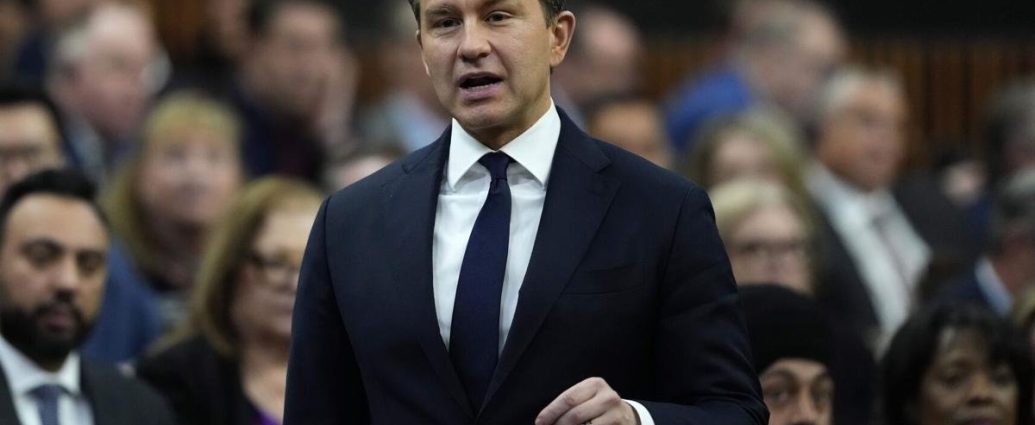
Pierre Poilievre walked into a packed room at the Château Laurier today and did something nobody saw coming. He offered to work with Mark Carney’s government.
The Conservative leader spent most of his 45-minute speech hammering the Liberals for what he called “fearmongering” about Donald Trump’s return to the White House. But when it came to actual policy, Poilievre struck a different tone entirely.
“We’ll work together where we can on the trade challenges facing our country,” he said during remarks to roughly 300 supporters and media members in Ottawa. “This isn’t about politics. It’s about protecting Canadian jobs and Canadian prosperity.”
The speech comes at a critical moment. Trump’s inauguration is just 72 hours away, and Canadian officials are scrambling to prepare for what could be the most challenging trade relationship in decades. With $428 billion in annual bilateral trade at stake, the political games that usually define Ottawa are giving way to something that looks almost like cooperation.
Taking Aim at Liberal Strategy
Look, Poilievre didn’t pull any punches when it came to Liberal messaging. He accused the party of using Trump as a boogeyman to distract from their own failures on the economy.
“The Liberals want Canadians to be afraid,” Poilievre told the crowd, his voice rising above scattered applause. “They want us to panic about things we can’t control instead of focusing on what we can.”
His message was simple: stop the hysteria, start the work (shocking, I know). But the numbers he cited painted a stark picture of why that work matters so much.
Canada sends 75.4% of its exports to the United States, worth approximately $429.8 billion in 2023 alone. That represents 2.1 million Canadian jobs directly tied to cross-border trade. When Trump talks about imposing 25% tariffs on Canadian goods, those aren’t abstract numbers. They’re paycheques for families from Windsor to Vancouver.
“Canada shouldn’t declare permanent rupture with the United States. We need to focus on what we can control and build from there. Fear isn’t a strategy, and panic isn’t a plan.”
That’s a marked shift from the usual opposition playbook. Instead of just attacking everything the government does, Poilievre’s drawing clear lines between what he’ll fight and what he’ll support.
The timing isn’t coincidental. Internal Conservative polling shows that 68% of Canadians want their political leaders to work together on US trade issues, even if they disagree on domestic policy. Poilievre’s team has been tracking these numbers for weeks, and they’ve shaped today’s message.
The Stoicism Strategy
Here’s where it gets interesting. Poilievre’s betting everything on what he calls “stoicism” over Liberal “fearmongering.”
He wants Canada to approach trade challenges with calm determination rather than panic. That means building economic strength at home while maintaining relationships abroad, even when those relationships get complicated.
“We can’t control what happens in Washington,” he said, pausing for effect. “But we can control what happens in Ottawa. We can control our tax rates, our regulatory burden, and our energy policies.”
The Conservative leader then laid out specific numbers to back up his point.
Canada’s federal tax burden has increased by 23.5% since 2015, he argued, making Canadian businesses less competitive against American rivals. Corporate tax rates sit at 26.7% when federal and provincial rates are combined, compared to 25.8% in the United States.
“Every percentage point matters when you’re competing for investment,” Poilievre said. “Every regulatory delay matters when you’re trying to get products to market.” It’s a smart political move, honestly. While the Liberals warn about Trump’s return, Poilievre’s positioning himself as the steady hand who can deliver results without drama.
The strategy has deeper roots than just this moment, though. Conservative strategists have been studying Ronald Reagan’s approach to dealing with difficult international partners.
The formula: project strength at home, engage pragmatically abroad, and don’t let emotions drive policy.
What This Means for Your Wallet
The bigger picture here matters for every Canadian business that exports south of the border. That’s a lot of jobs and a lot of money hanging in the balance.
Take the automotive sector.
Ontario’s auto plants shipped $48.2 billion worth of vehicles and parts to the US in 2023. A 25% tariff would add roughly $12 billion in costs that someone has to absorb. Either Canadian companies eat those costs and go broke, or American consumers pay higher prices and buy fewer Canadian products.
Sarah Chen, president of the Canadian Manufacturing Association, was in the audience today. She’s been pushing for exactly this kind of political cooperation.
“We can’t afford to have our political leaders fighting each other while our biggest customer is threatening our livelihoods. Pierre’s offer today is exactly what Canadian manufacturers have been asking for. We need all hands on deck.”
The energy sector faces similar pressures (not a typo). Canada exported $156.8 billion worth of oil, gas, and electricity to the US last year. Trump’s “drill, baby, drill” agenda could flood American markets with domestic production, squeezing out Canadian supplies.
Hard to ignore.
Poilievre’s cooperation offer isn’t just politics.
It’s recognition that some fights are too important for partisan games. But it’s also recognition that his party’s traditional strength on economic issues could be the key to solving these problems.
Thing is, this comes as businesses across the country are already bracing for potential tariffs and trade disputes. The Canadian Chamber of Commerce released a survey last week showing that 73% of export-dependent businesses have already started contingency planning for trade disruptions.
The Trump Factor Nobody’s Talking About
But wait. Poilievre still took plenty of shots at Trump’s approach to trade, just not in the way most people expected.
He called out what he sees as unpredictable policy swings from the White House. The message: Canada needs to be prepared for anything while not letting fear drive decisions.
“We face Trump with stoicism, not Liberal fearmongering,” became his rallying cry for the speech.
“We engage with facts, not feelings.” That’s classic Poilievre. Take a shot at both the Americans and the Liberals in the same breath, but do it in a way that sounds statesmanlike rather than petty.
The Conservative leader then did something unexpected. He praised some aspects of Trump’s first-term trade record, noting that bilateral trade actually increased by 14.2% between 2017 and 2019, before the pandemic hit.
“President Trump is a negotiator,” Poilievre said. “He makes big demands to get attention, then he makes deals. Our job is to make sure those deals work for Canadians.”
It’s a risky position that could backfire if Trump follows through on his most extreme threats. But it could also position Poilievre as the Canadian leader who “gets” how to deal with the incoming president.
Playing the Long Game
If you’re wondering why this matters politically, here’s the thing. Poilievre’s trying to look prime ministerial without actually being prime minister.
By offering cooperation on trade, he’s showing he can put the country first when it counts. By attacking Liberal messaging, he’s still playing opposition politics.
It’s a careful balance that his advisors have been crafting for months.
The electoral math is straightforward. Conservative internal polling shows them leading by 18 points nationally, but that lead could evaporate quickly if a trade war starts hitting Canadian pocketbooks. Voters might rally around whatever government is actually in power if they think it’s doing everything possible to protect jobs.
Too much cooperation and his base gets restless. Too much opposition and he looks petty on serious issues that affect real families. The sweet spot is offering help while making it clear he’d do things differently if he were in charge.
The question is whether Carney’s government will take him up on the offer. Given the stakes involved, they might not have much choice. The Liberals are already facing pressure from provincial premiers, business groups, and even some of their own backbench MPs to build the broadest possible coalition for trade talks.
What This Means for Your Family’s Future
Strip away the political theater, and this is about your grocery bill, your job security, and your family’s future prosperity.
Canadian families spend an average of $12,935 per year on goods that cross the US border at some point in the supply chain. That includes everything from Florida oranges to Canadian wheat that gets processed in American mills then shipped back as flour.
If Trump’s tariffs become reality, economists estimate the average Canadian household could see costs rise by $1,200 to $1,800 annually. That’s a mortgage payment for many families. It’s a vacation that doesn’t happen, or a car repair that gets delayed.
The job impacts could be even more severe. The Canadian Labour Congress estimates that 340,000 jobs could be at risk if trade flows decrease by just 15%. These aren’t abstract statistics. They’re plant closures in small towns, layoffs at factories that have operated for generations, and young people leaving regions that lose their economic base.
Poilievre seemed to understand this when he wrapped up his remarks. “This isn’t about scoring political points,” he said, his voice dropping to almost a whisper. “This is about whether Canadian families can afford to fill up their gas tanks and feed their kids.”
The Conservative leader then made a direct appeal to working-class voters who might be skeptical of political cooperation. “I’ll work with anyone, even people I disagree with, if it means protecting your paycheque. That’s not weakness. That’s leadership.”
Where We Go From Here
So where does this leave Canada as Trump prepares to take office in 72 hours?
Carney’s office has already indicated they’re open to Conservative input on trade strategy. Deputy Prime Minister Freeland met with Conservative trade critics twice last week, though those conversations were kept private.
The real test will come when Trump starts making specific demands. Will Poilievre’s offer of cooperation hold up when the pressure gets intense?
Will the Liberals actually listen to Conservative ideas, or is this just window dressing?
“Draw your own conclusions about whether this represents a real shift or just good politics,” Poilievre said as he wrapped up his remarks. “But the offer stands. Canada’s workers and families deserve nothing less than our best effort.”
The next few weeks will show whether Canadian politics can rise above partisan warfare when the stakes are this high. For millions of Canadian families whose livelihoods depend on trade with the US, the answer can’t come soon enough.
Frequently Asked Questions
What cooperation is Poilievre offering Carney?
Poilievre says he’ll work with Carney’s government on trade challenges facing Canada, particularly those involving the United States.
Why is Poilievre criticizing Liberal messaging?
He accuses the Liberals of using Trump as fearmongering to distract from their own policy failures rather than focusing on solutions.
What does this mean for Canada-US trade?
With 75% of Canadian exports going to the US, any cooperation on trade policy could help stabilize the relationship worth hundreds of billions annually.