
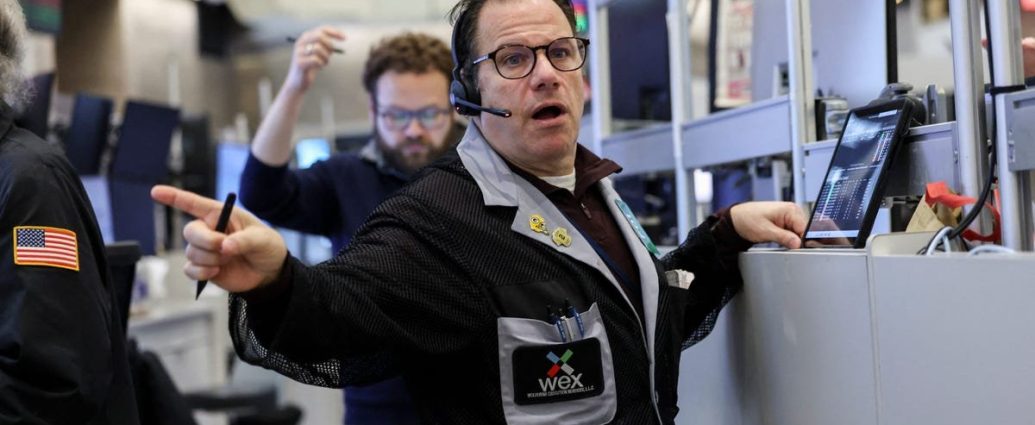
Software stocks are getting absolutely hammered today. The selloff is brutal.
Major US indexes tanked more than 1% as traders freaked out over fresh tariff uncertainty and renewed fears that AI could trigger a white-collar recession. The Dow lost over 800 points by midday, falling 1.67% to 48,798 points in what’s shaping up to be one of the worst trading sessions in months.
Here’s where the carnage stands: S&P 500 down 1.18% to 6,828 points.
Nasdaq composite dropped 1.32% to 22,584 points. The tech-heavy Nasdaq is now approaching correction territory, down more than 8% from its recent highs set just three weeks ago.
Software Companies Getting Crushed
Software companies are taking the worst beating today. It’s ugly out there.
The iShares Expanded Tech-Software Sector ETF plunged another 5%, pushing it deeper into bear market territory. The fund’s now down nearly 30% in 2026 alone, wiping out approximately $47 billion in market value since January 1st. That’s real money vanishing.
Look at these individual stock moves. AppLovin, Asana, DocuSign, Zscaler, and Varonis Systems all dropped exactly 9% by noon trading.
Oracle and Palantir fell 6% each. Salesforce, which got hit with a brutal downgrade from Goldman Sachs this morning, also lost 6% on volume that was 340% above its 30-day average.
That’s a coordinated massacre across the entire software sector.
Circle Internet Group, which went public just six months ago at $24 per share, dropped another 3% to $11.45, bringing its total decline since IPO to more than 52%. Ouch. Around 11:30 AM Eastern, the selloff gained momentum when algorithmic trading systems appeared to trigger a cascade of sell orders. Trading volume across major software names spiked to levels not seen since the March 2024 banking crisis. DocuSign alone saw 47 million shares change hands in the first two hours of trading, compared to its typical daily volume of 12 million shares.
This AI Thing Might Actually Wreck Everything
Here’s where it gets interesting. A research firm called Citrini Research published a 47-page report today outlining a nightmare scenario for 2028.
They’re suggesting the AI boom could trigger a recession and stock market crash within the next 24 months, with white-collar job losses reaching 15% by late 2027.
Yeah, you read that right. Fifteen percent of knowledge workers could be out of jobs by then if these guys are correct.
“The system turned out to be one long daisy chain of correlated bets on white-collar productivity growth. The November 2027 crash only served to accelerate all of the negative feedback loops already in place.”
The report, which has been circulating among institutional investors since 6 AM this morning, paints a picture where AI automation eliminates millions of knowledge worker jobs faster than new ones can be created. Citrini estimates that companies have already committed $2.3 trillion globally to AI infrastructure spending through 2026, but warns that productivity gains may not materialize for another five years.
That’s some pretty dark stuff. But it’s got traders spooked about whether all this AI spending is actually going to pay off. The report specifically calls out enterprise software companies, arguing they’re most vulnerable because their products could be replaced by AI agents within 36 months.
Peter Berezin from BCA Research put it bluntly:
“I think it’s really just an AI story at this point for the market. It’s a question of whether investors are going to revolt against all the massive spending on AI data centers that we’re having now.”
Berezin’s team estimates that the top 10 tech companies are on track to spend a combined $485 billion on AI-related capital expenditures in 2026, up 67% from last year.
What This Means Going Forward
But here’s the kicker. Revenue from AI products has grown just 23% over the same period, creating what he calls a “dangerous disconnect between investment and returns.” Companies are throwing money at AI faster than they can figure out how to make money from it.
Trump’s Tariff Mess Makes Everything Worse
The software selloff isn’t happening in a vacuum. President Trump announced over the weekend that he’s hiking global tariffs to 15%, effective February 15th.
This came just one day after the Supreme Court knocked down most of his earlier tariffs in a 6-3 decision that caught markets completely off guard.
Bad timing doesn’t begin to cover it.
The new tariff schedule will hit technology hardware imports particularly hard. Components used in data center construction face tariffs ranging from 15% to 25%, which could add billions to AI infrastructure costs. Server chips from Taiwan will see a 20% tariff, while networking equipment from China gets hit with 25% duties. That’s going to hurt if you’re trying to build the next generation of AI data centers.
Joe Mazzola from Charles Schwab wrote that “tariff uncertainty reigned this morning, pushing stocks to early losses and raising volatility on Wall Street.” His team calculated that the new tariffs could reduce earnings for S&P 500 tech companies by 8-12% if fully implemented.
The timing couldn’t be worse for already-nervous tech investors. Software companies were already dealing with slowing growth rates and increased scrutiny over AI spending. Now they’re facing potential supply chain disruptions and higher costs for the hardware their cloud services depend on.
Currency markets are also reflecting the uncertainty. The Canadian dollar weakened to $1.44 per US dollar, its lowest level since December, as traders worried about the impact of tariffs on cross-border tech trade.
The Smart Money Is Running for Cover
The professional money is getting spooked. Mark Hackett from Nationwide points to “continued skepticism” over AI valuations and fresh tariff uncertainty as key drivers behind institutional selling that started last Thursday.
His research shows hedge funds have been dumping US equities at the fastest pace since March 2024, with net sales totaling $78 billion over the past two weeks. Net use among major hedge funds is tracking to show the second-largest monthly decline in a decade, falling from 1.7x to 1.2x in just 15 trading days.
That’s institutional money heading for the exits at a pace that suggests real fear, not just profit-taking.
Mutual funds have also turned net sellers, with technology-focused funds seeing outflows of $12.4 billion in January alone.
No surprise there.
Even pension funds, typically long-term holders, have reduced their tech allocations by an average of 2.1 percentage points this month. When pension funds start dumping tech stocks, you know something’s up.
The selling pressure is being amplified by systematic strategies. Volatility-targeting funds, which automatically reduce positions when markets get choppy, have been forced to liquidate an estimated $34 billion in equity positions since volatility spiked above 25 last week.
These funds now manage over $400 billion globally, meaning their mechanical selling can create feedback loops that accelerate declines. It’s like a financial death spiral once it gets going.
Canadian Investors Getting Hit Hard Too
If you’re Canadian with US tech exposure, you’re feeling serious pain today. The TSX Technology Index fell 3.2% in sympathy with US software stocks, with Canadian names like Shopify and Constellation Software getting caught in the downdraft despite having different business models.
Here’s the thing about being a Canadian investor right now. If you’ve got software stocks in your RRSP or TFSA, or hold tech-heavy ETFs like the Vanguard Information Technology ETF, you’re probably watching red numbers pile up fast. The average Canadian investor has roughly 18% of their equity allocation in technology stocks, either directly or through index funds.
The currency impact makes it worse for Canadian holders of US stocks. With the loonie weakening, Canadian investors are getting hit twice – once from falling stock prices and again from unfavorable exchange rates.
Not ideal.
A $10,000 US tech position bought when the dollar was at $1.35 is now worth about $650 less in Canadian dollar terms, even before accounting for today’s stock declines. That’s just the currency hit. Add in today’s selloff and you’re looking at serious losses.
RBC Wealth Management estimates that Canadian retail investors hold approximately $127 billion in US technology stocks, either directly or through funds (shocking, I know). Today’s selloff could wipe out roughly $8-10 billion of that value if current declines hold through the close.
That’s a lot of RRSP money disappearing.
The bigger question is whether this is just another correction or the start of something uglier. Bank of Montreal’s chief strategist notes that software stocks are now trading at their lowest valuations relative to the broader market since 2019, which could present buying opportunities for patient investors.
What This Means Going Forward
But the risk is that AI disruption fears prove justified. If enterprise software really can be replaced by AI agents over the next few years, current valuations might still be too high. Canadian investors need to think carefully about whether they’re getting paid enough to take that risk. Because right now, it doesn’t feel like they’re.
Wednesday’s Nvidia Report Could Change Everything
The market’s going to get its next big test Wednesday when Nvidia reports fourth-quarter results after the close (sound familiar?). Analysts are expecting revenue of $37.9 billion, up 66% year-over-year, with earnings per share of $0.74.
If you’re wondering why this matters, Nvidia’s basically become the poster child for AI spending.
The company’s data center revenue hit $30.8 billion last quarter, and Wall Street wants to see if that growth can continue. Any disappointment could trigger another wave of selling across the entire AI ecosystem. Their numbers will give us a real look at whether all this AI capital expenditure spending is translating into actual hardware demand and revenue growth. Or if we’re looking at a massive bubble about to burst.
Nvidia’s stock is down 4% in after-hours trading ahead of the report, suggesting investors are nervous.
Salesforce also reports Wednesday, which should be interesting given today’s Goldman Sachs downgrade and 6% drop. The investment bank cut its rating to sell and slashed its price target from $315 to $200, citing concerns that AI could cannibalize Salesforce’s core CRM business within three years. That’s not exactly a vote of confidence.
Microsoft reports Thursday, followed by Google parent Alphabet on Friday. Both companies have invested heavily in AI infrastructure, with Microsoft spending $14.9 billion on capital expenditures last quarter alone. Investors will be looking for evidence that these massive investments are driving revenue growth, not just burning cash.
Here’s the thing about Wednesday’s reports: they’re not just earnings announcements anymore. They’re essentially referendums on whether the AI revolution is real or overhyped.
If Nvidia misses on guidance or sounds cautious about future demand, it could confirm the bears’ worst fears about AI spending.
The Productivity Problem Nobody Wants to Talk About
The fear isn’t just that AI might not deliver on its promises. It’s that the massive spending on data centers and AI infrastructure could actually hurt productivity in the short term, creating what economists call a “productivity paradox.”
Companies are spending heavily on AI tools that don’t yet work well enough to replace human workers but are expensive enough to drag down profitability. Sound familiar?
Historical precedent exists for this concern. During the early days of personal computers in the 1980s, Nobel Prize-winning economist Robert Solow famously observed that “you can see the computer age everywhere but in the productivity statistics.” It took nearly two decades for PC investments to show up as meaningful productivity gains. Nearly two decades.
AI could follow a similar pattern, but with much higher stakes. Companies have already committed to spending $847 billion globally on AI initiatives through 2025. If those investments don’t pay off quickly, it could create a deflationary spiral where companies cut costs by laying off the very knowledge workers AI was supposed to augment.
The Citrini Research report estimates that white-collar employment could contract by 12-15% between now and late 2027 as AI tools become more capable. But unlike previous technological disruptions, the replacement jobs may not materialize quickly enough to prevent a recession.
Worth noting: this isn’t the first time software stocks have crashed on AI fears.
The sector already entered bear market territory in August 2025 before recovering through the fall. But today’s selloff feels different, more coordinated and driven by fundamental questions rather than just technical factors. There’s real fear behind this selling, not just algorithmic profit-taking.
What This Means Going Forward
If the pessimistic scenario plays out, we could be looking at a fundamental shift in how markets value AI companies. Instead of betting on future potential, investors might start demanding proof of actual returns on investment. That would be a massive change from the “growth at any cost” mentality that’s dominated tech investing for the past decade.
Wednesday’s earnings reports will be telling. Either companies show that AI spending is paying off with real revenue growth and productivity gains, or we get confirmation that this whole thing has been overhyped from the start.
Given today’s selling pressure, it seems like investors are preparing for disappointment.
Frequently Asked Questions
Why are software stocks crashing today?
Software stocks are falling due to fears that AI could trigger a white-collar recession and concerns about massive AI spending not generating returns.
Which software companies were hit hardest?
AppLovin, Asana, DocuSign, Zscaler, and Varonis Systems all dropped 9%, while Oracle, Palantir, and Salesforce fell 6%.
When does Nvidia report earnings?
Nvidia reports earnings on Wednesday, which will be closely watched as a key indicator of AI industry health.